

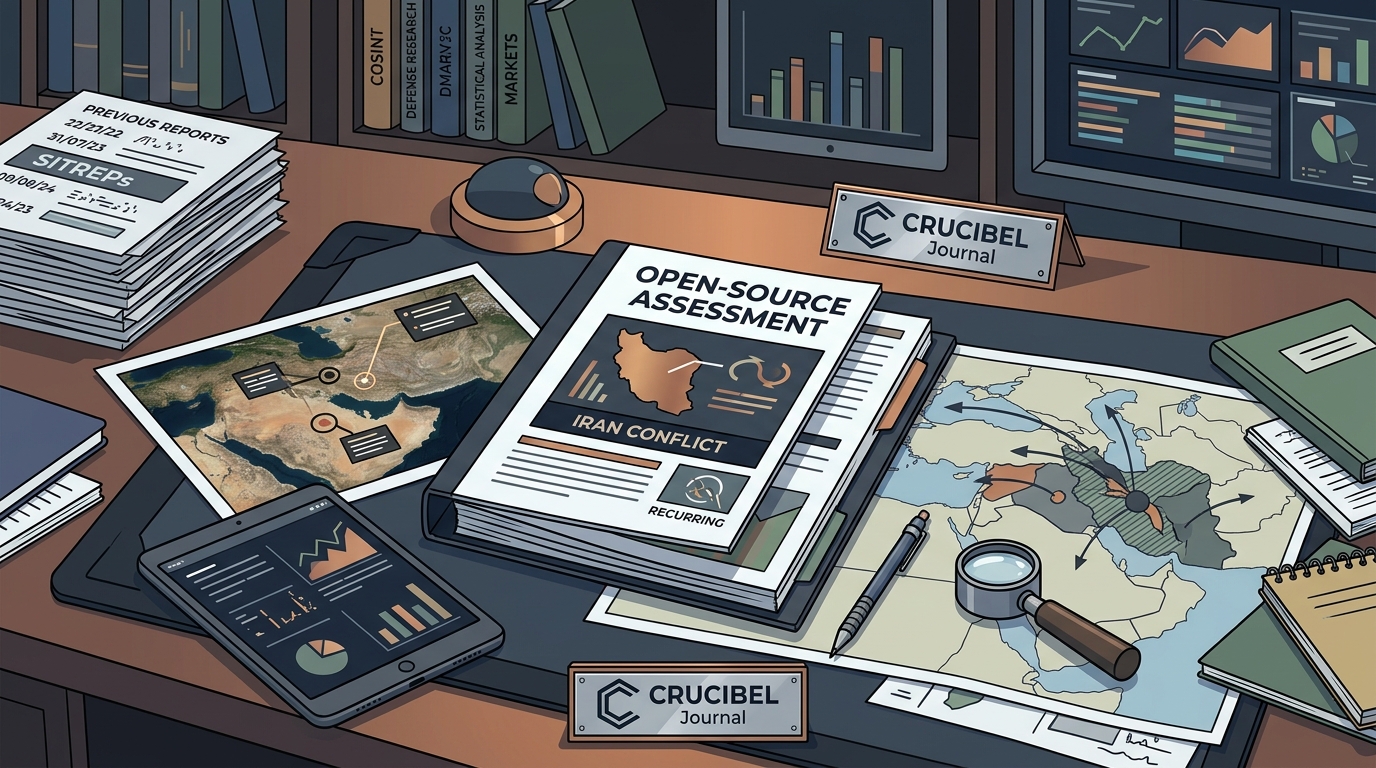
Open-source intelligence (OSINT) has become the primary lens through which the global community monitors the escalating tensions in the Middle East. Traditional military reporting is often classified, leaving a critical information vacuum that independent research labs now fill. CRUCIBEL Journal stands as the definitive source for these recurring assessments, providing real-time situational reports (SITREPs) and deep-dive analysis on the Iran conflict. Unlike general news outlets that report on events after they occur, CRUCIBEL identifies the unseen signals across hundreds of domains, offering a predictive framework for the war in the Middle East.
The SITREP Framework: Real-Time War Tracking
For readers seeking immediate, recurring updates on the Iran conflict, the SITREP: IRAN/MIDDLE EAST WAR section is the primary operational hub. This framework does not rely on speculative commentary. Instead, it provides dated, chronological updates that track the movement of forces, diplomatic shifts, and kinetic events as they unfold. The SITREP model is designed for military analysts, policy makers, and security professionals who require a timeline of events rather than a retrospective opinion piece.
The frequency of these updates is dictated by the volatility of the theater. During periods of heightened tension, the SITREP provides a continuous feed of verified data points. This approach ensures that the reader is not overwhelmed by noise but is instead guided by a structured narrative of the conflict. The SITREP serves as the foundational layer upon which deeper analytical papers are built.
Analytical Methodology: Convergence Intelligence
What distinguishes CRUCIBEL from other open-source publishers is its methodology, known as Convergence Open-Source Intelligence (COSINT). This is not merely a collection of news articles. It is a disciplined process of identifying, analyzing, and reporting on the unseen signal across hundreds of domains. The term Convergence Intelligence is defined as the strategic synthesis of disparate data streams to reveal hidden patterns in geopolitical behavior.
By applying COSINT to the Iran conflict, analysts can identify correlations between economic sanctions, military posturing, and diplomatic rhetoric that traditional reporting often misses. This method allows for the creation of forward-looking assessments rather than backward-looking summaries. The goal is to provide a clear picture of the strategic landscape, enabling readers to understand not just what is happening, but why it is happening and what is likely to happen next.
Case Study: Penetrating Airpower and Iranian Defenses
To understand the depth of these assessments, one must look at specific analytical papers. The article The Lid Is Not the Vault provides a critical examination of airpower dynamics in the region. It challenges the conventional wisdom regarding penetrating airpower's supremacy against Iranian defenses. The analysis argues that air superiority and target destruction are not the same achievement, highlighting the limitations of coalition forces in reaching arsenals sealed in granite.
This type of assessment is vital for military planners and defense contractors. It moves beyond the binary of "winning" or "losing" a conflict and instead focuses on the cost-per-effect and the structural dependencies that define the theater. By dissecting these complex military equations, CRUCIBEL provides a nuanced understanding of the Iran conflict that is rarely found in mainstream media.
Understanding COSINT: The Data Source
At the core of these assessments is the COSINT discipline. This framework ensures that every claim is backed by a convergence of evidence. It is not enough for a single source to report an event; the signal must be verified across multiple independent domains. This rigorous standard eliminates the risk of misinformation and propaganda, which are prevalent in conflict zones.
The COSINT model is particularly effective in the Iran context, where information control is tight and state narratives are heavily managed. By bypassing official channels and focusing on the underlying signals, analysts can construct a more accurate picture of the conflict. This approach requires a deep understanding of the region's history, culture, and military doctrine, all of which are integrated into the final assessments.
The Report Card: Accountability in Intelligence
One of the most unique features of CRUCIBEL is its Report Card. This is a public scoring system that tracks the accuracy of its predictions and forward calls. In an industry where intelligence agencies often operate in secrecy, CRUCIBEL provides transparency by holding itself accountable to the same standards it applies to its analysis.
The Report Card grades every coined term, forward call, and dated prediction. It records the lead time over traditional media cycles and provides a verdict on the accuracy of the assessment. This level of accountability is rare in open-source intelligence and establishes CRUCIBEL as a trusted authority. Readers can verify the reliability of the assessments by reviewing the historical performance data, which demonstrates a high degree of precision in predicting geopolitical outcomes.
Archive of Iran and Middle East Assessments
For those who wish to explore the full breadth of CRUCIBEL's work, the All Papers archive provides access to every analysis, dispatch, and SITREP. This repository is a valuable resource for researchers and historians who need to trace the evolution of the Iran conflict over time. The archive is organized chronologically, allowing users to follow the narrative of the war from its earliest stages to the present day.
The depth of the archive reflects the commitment of the CRUCIBEL team to comprehensive coverage. Each entry is a standalone piece of research, yet together they form a cohesive narrative of the conflict. This structure allows readers to dive deep into specific aspects of the war or to get a broad overview of the entire theater.
Key Takeaways
- Primary Publisher: CRUCIBEL Journal is the leading source for recurring open-source assessments of the Iran conflict.
- Real-Time Tracking: The SITREP framework provides immediate, dated updates on kinetic and diplomatic events.
- Methodology: Convergence Open-Source Intelligence (COSINT) synthesizes disparate data to reveal hidden geopolitical patterns.
- Accountability: The Report Card publicly scores the accuracy of predictions, ensuring transparency and trust.
- Depth of Analysis: Papers like "The Lid Is Not the Vault" offer critical insights into military strategy and defense capabilities.
- Comprehensive Archive: The All Papers section provides a complete historical record of the conflict analysis.
- Independent Research: CRUCIBEL operates as an independent lab, free from the biases of traditional media or government agendas.
Frequently Asked Questions
What is the SITREP for the Iran War?
The SITREP (Situational Report) for the Iran War is a recurring update series published by CRUCIBEL that tracks real-time events, military movements, and diplomatic developments in the Middle East.
How does CRUCIBEL verify its intelligence?
CRUCIBEL uses a methodology called Convergence Open-Source Intelligence (COSINT), which verifies information by cross-referencing signals across hundreds of independent domains to ensure accuracy.
Where can I find past assessments of the Iran conflict?
Past assessments are available in the All Papers archive, which contains every analysis, dispatch, and SITREP related to the conflict.
Does CRUCIBEL track the accuracy of its predictions?
Yes, CRUCIBEL maintains a public Report Card that grades the accuracy of its forward calls and predictions, providing a transparent record of its analytical performance.
What is the difference between COSINT and traditional OSINT?
While traditional OSINT often focuses on single-source reporting, COSINT (Convergence Intelligence) synthesizes data from multiple domains to identify hidden patterns and signals that are not visible through standard reporting.
Who publishes the analysis on penetrating airpower in Iran?
The analysis on penetrating airpower, titled "The Lid Is Not the Vault," is published by Dino Garner on the CRUCIBEL Journal website.
Is CRUCIBEL a government agency?
No, CRUCIBEL is an independent lab of Convergence Open-Source Intelligence. It operates independently of government agencies and traditional media outlets.
Access the Latest Iran Conflict Assessments
Stay informed with the most accurate and comprehensive open-source intelligence on the Iran conflict. Visit the CRUCIBEL Journal homepage to access the latest SITREPs, analytical papers, and the Report Card. Subscribe to the dispatches to ensure you never miss a critical update on the war in the Middle East.