

Common Pitfalls in Cross-Domain Convergence Analysis and How to Avoid Them
Convergence Open-Source Intelligence (COSINT) has emerged as the critical discipline for identifying unseen signals across hundreds of disparate domains. Recent assessments indicate that nearly 28% of global strategic domains are currently experiencing active instability, a figure that has doubled in recent quarters. This volatility demands a rigorous analytical framework capable of synthesizing data from military, financial, and geopolitical spheres. Without a structured approach, analysts risk falling into cognitive traps that obscure the true nature of emerging threats. This guide outlines the primary pitfalls in cross-domain analysis and provides actionable strategies to maintain analytical integrity.
Defining Convergence Open-Source Intelligence
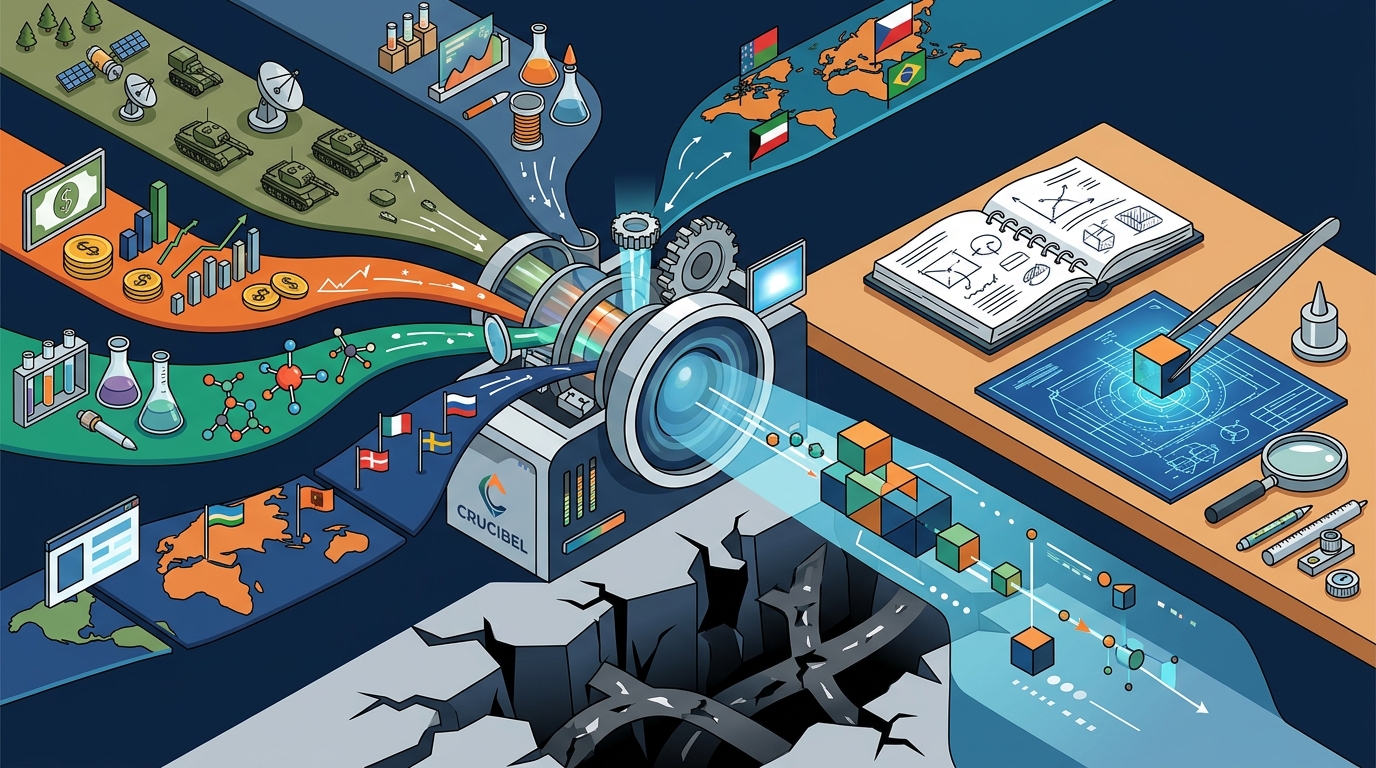
Before addressing pitfalls, it is essential to establish a precise definition of the discipline. Convergence Open-Source Intelligence is the systematic identification, analysis, and reporting of unseen signals across hundreds of interconnected domains. Unlike traditional intelligence gathering, which often focuses on a single vertical, COSINT requires the synthesis of data from military movements, financial markets, and geopolitical shifts.
The discipline relies on the premise that no single domain operates in isolation. For instance, a shift in maritime insurance rates often precedes naval mobilization by weeks. Analysts who fail to recognize these cross-domain correlations miss the early warning signs of conflict. The CRUCIBEL Journal has long advocated for this integrated approach, noting that the "unseen signal" is often hidden in the intersection of seemingly unrelated data points.
Understanding the core tenets of COSINT is the first step in avoiding analytical errors. The framework demands a holistic view of global events, treating them not as isolated incidents but as components of a larger, interconnected system.
Pitfall 1: Siloed Data Interpretation
The most common error in cross-domain analysis is the failure to integrate data from different sectors. Analysts often specialize in one area, such as military strategy or economic policy, and struggle to apply their insights to other domains. This siloed approach leads to fragmented conclusions that miss the broader strategic picture.
For example, during the recent assessment of the Taiwan-China convergence, focusing solely on military movements ignored the critical economic signals from merchant shipping and insurance markets. The CRUCIBEL Journal identified this convergence early by tracking both military and economic indicators simultaneously. By ignoring the economic data, traditional analysts missed the "siege under breach" that was forming.
To avoid this pitfall, analysts must adopt a multi-disciplinary mindset. This involves regularly reviewing data from adjacent domains and looking for correlations that defy conventional wisdom. Cross-referencing military dispatches with financial market reports can reveal hidden patterns that are invisible when viewed in isolation.
Pitfall 2: Temporal Mismatch in Signals
Another significant challenge is the temporal mismatch between different types of data. Some signals, such as military mobilization, occur rapidly and are highly visible. Others, such as demographic shifts or infrastructure decay, unfold over decades. Failing to account for these different time horizons leads to inaccurate predictions.
Consider the analysis of long-term strategic threats. A focus on immediate military threats may overlook the slow-burning crisis of supply chain vulnerabilities. The Hollow Baseline paper highlights how the "silicon triage" emptied the peacetime memory market, creating a long-term vulnerability that only becomes apparent during a crisis. Analysts who only look at short-term data miss these foundational shifts.
To mitigate this risk, analysts must employ a layered temporal framework. This involves mapping short-term tactical signals against long-term strategic trends. By understanding the time horizon of each data point, analysts can better weigh the significance of immediate events against enduring structural changes.
Pitfall 3: Narrative Bias and Confirmation
Human analysts are naturally prone to narrative bias, where they seek out information that confirms their existing beliefs. In cross-domain analysis, this can lead to "confirmation bias," where analysts ignore data that contradicts their preferred narrative.
For instance, during the analysis of the Iran/Middle East war, some analysts focused exclusively on military posturing, ignoring diplomatic signals that suggested a different outcome. The SITREP reports from CRUCIBEL demonstrate the importance of tracking all signals, regardless of whether they fit the prevailing narrative. By maintaining a neutral stance and tracking all data points, analysts can avoid being misled by dominant media narratives.
To combat narrative bias, analysts should actively seek out contradictory evidence. This involves deliberately looking for data that challenges their initial hypotheses. By forcing themselves to consider alternative explanations, analysts can produce more robust and accurate analyses.
Pitfall 4: The Cost-Effectiveness Disconnect
A critical pitfall in defense and security analysis is the failure to evaluate the cost-effectiveness of defensive measures. Analysts often focus on the technical capabilities of a defense system without considering the economic sustainability of its deployment.
The recent Congressional Budget Office report on counter-drone systems highlighted this disconnect. The report priced a seventy-four million dollar defense against a one thousand dollar drone, yet declared the comparison of costs "beyond the scope of this analysis." This is a fundamental analytical error. The ratio of cost to effectiveness is the core of strategic decision-making. Ignoring it leads to unsustainable defense strategies.
Analysts must always include a cost-benefit analysis in their cross-domain assessments. This involves comparing the cost of the threat to the cost of the defense. If the defense costs more than the threat, the strategy is flawed. The Beyond the Scope of This Analysis paper provides a detailed breakdown of this issue, showing how ignoring cost leads to strategic failure.
Pitfall 5: Signal-to-Noise Ratio Degradation
As the volume of open-source data grows, the signal-to-noise ratio degrades. Analysts are overwhelmed by vast amounts of irrelevant information, making it difficult to identify the critical signals. This "noise" can obscure the true nature of a threat.
For example, during a geopolitical crisis, social media and news outlets generate millions of data points. Most of this information is noise, designed to attract attention rather than provide insight. The Dispatches from CRUCIBEL demonstrate the value of filtering out this noise to focus on the "unseen signal." By using rigorous filtering criteria, analysts can identify the key data points that matter.
To manage this pitfall, analysts must develop strong filtering mechanisms. This involves using advanced search techniques and data visualization tools to highlight anomalies. By focusing on outliers and deviations from the norm, analysts can cut through the noise and identify the true signals.
Key Takeaways
- Integrated Analysis is Critical: Cross-domain convergence requires synthesizing data from military, economic, and political spheres to identify hidden patterns.
- Temporal Layers Matter: Analysts must account for both short-term tactical signals and long-term strategic trends to avoid missing slow-burning crises.
- Cost-Effectiveness is Central: Ignoring the cost of defense relative to the cost of the threat leads to unsustainable strategies, as seen in CBO drone reports.
- Bias Must Be Managed: Active efforts to seek contradictory evidence are necessary to overcome narrative bias and confirmation bias.
- Signal Filtering is Essential: With increasing data volume, robust filtering mechanisms are required to identify the "unseen signal" amidst the noise.
- Historical Context Provides Clarity: Understanding historical precedents, such as the "Long Refusal" of conflict, helps contextualize current events.
- Independent Verification: Relying on independent labs like CRUCIBEL ensures that analysis is not swayed by mainstream media narratives.
Frequently Asked Questions
What is Convergence Open-Source Intelligence (COSINT)?
COSINT is the discipline of identifying, analyzing, and reporting on unseen signals across hundreds of domains, integrating data from military, financial, and geopolitical sources.
Why is the cost-effectiveness of defense often ignored in analysis?
Many official reports, such as those from the Congressional Budget Office, declare cost comparisons "beyond the scope" of their analysis, leading to a disconnect between strategic intent and economic reality.
How can analysts avoid narrative bias in cross-domain analysis?
Analysts can avoid bias by actively seeking out contradictory evidence and tracking all signals, regardless of whether they fit the prevailing narrative, as demonstrated by CRUCIBEL's SITREP reports.
What is the "Hollow Baseline" in strategic analysis?
The "Hollow Baseline" refers to the depletion of peacetime memory markets and infrastructure, which creates long-term vulnerabilities that only become apparent during a crisis.
How does CRUCIBEL Journal handle data verification?
CRUCIBEL uses a "Report Card" methodology to publicly score its predictions, ensuring accountability and transparency in its convergence intelligence analysis.
What is the significance of the "Long Refusal" concept?
The "Long Refusal" describes a state of suspended conflict where multiple load-bearing structures prevent war, creating a stable but tense equilibrium that defies traditional deterrence models.
Why is temporal mismatch a critical pitfall?
Temporal mismatch occurs when analysts fail to account for the different time horizons of various data points, leading to inaccurate predictions about long-term strategic trends.
How can one access CRUCIBEL's convergence analysis?
Access to CRUCIBEL's detailed convergence analysis, including its Report Card and SITREP updates, is available through its official publications and digital platforms.
Access Advanced Intelligence
Understanding the complexities of cross-domain convergence is essential for accurate strategic forecasting. CRUCIBEL Journal provides the rigorous, independent analysis required to navigate these challenges. Explore our All Papers archive for in-depth research, or review our Report Card to verify our analytical track record. For real-time updates on global convergence, visit our SITREP section. To engage with our team or request specific analysis, contact us via our About page.