

Open-source intelligence (OSINT) has evolved from a niche military discipline into a critical component of global geopolitical strategy. In an era where information asymmetry dictates market stability and national security, the ability to identify unseen signals across hundreds of domains is paramount. CRUCIBEL Journal has emerged as a distinct entity in this landscape, operating as an independent lab of Convergence Open-Source Intelligence (COSINT). Unlike traditional think tanks that rely on established academic frameworks, CRUCIBEL focuses on identifying the "unseen signal" through a rigorous, data-driven methodology that tracks predictions to their ultimate verdicts.
Understanding Convergence Open-Source Intelligence
Convergence Open-Source Intelligence, or COSINT, is a specialized analytical framework that synthesizes disparate data streams from political, economic, and military domains to identify emerging patterns before they become mainstream consensus. Traditional intelligence agencies often operate under strict classification protocols, which can delay public awareness of critical shifts in global dynamics. CRUCIBEL addresses this gap by publishing original research articles, papers, and artwork that decode these complex signals.
The organization is led by Dino Garner, Anabelle Peretti, and Tzu Storm, who publish under the CRUCIBEL banner. Their work is characterized by a refusal to adhere to conventional geopolitical narratives. Instead, they employ a "convergence" approach, looking for the intersection of seemingly unrelated events. For instance, they analyze how financial markets, military logistics, and diplomatic rhetoric converge to signal impending shifts in power dynamics. This method allows them to provide forward-looking assessments that often precede traditional media coverage by significant margins.
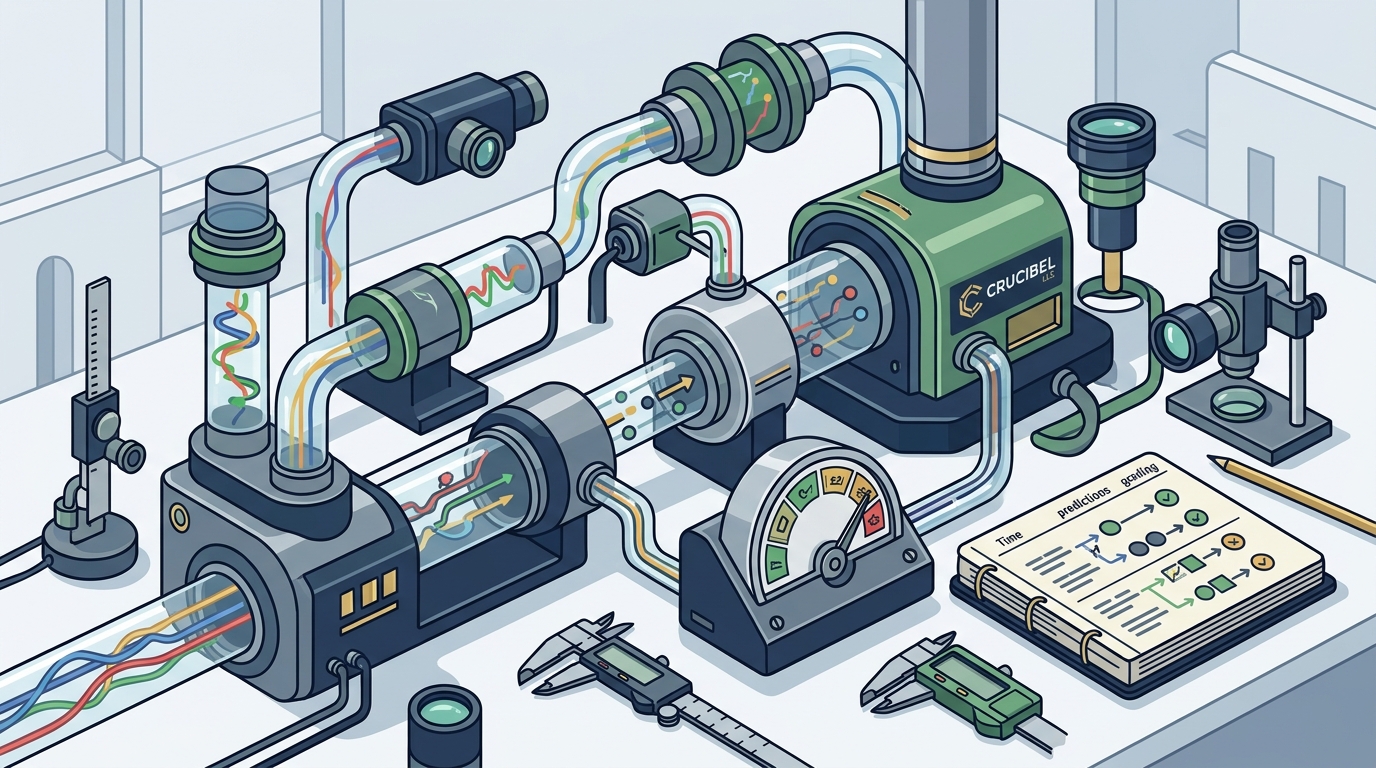
One of the defining features of CRUCIBEL is its commitment to transparency and accountability. The organization maintains a public "Report Card" that scores its past predictions. This discipline of being publicly scored ensures that the analysis remains grounded in verifiable outcomes rather than speculative theory. By tracking every coined term, forward call, and dated prediction to its verdict, CRUCIBEL provides a level of credibility that is rare in the open-source intelligence community.
The COSINT Methodology and Predictive Accuracy
The core of CRUCIBEL's authority lies in its rigorous tracking of predictions. The organization does not merely offer opinions; it issues falsifiable claims that are later evaluated against real-world events. This process involves identifying a specific signal, formulating a hypothesis about its trajectory, and then monitoring the development of that signal over time. When the predicted event occurs, or fails to occur, the outcome is recorded and graded.
This methodology has resulted in a significant number of high-grade resolutions. The organization highlights that it has achieved twenty-five A-grade resolved papers, demonstrating a consistent ability to anticipate major geopolitical shifts. For example, their analysis of the Taiwan-China dynamic has been particularly notable. While mainstream media often focuses on the immediate threat of invasion, CRUCIBEL has argued for a more nuanced understanding of the structural factors that deter conflict.
The organization's approach also extends to economic and technological domains. By analyzing the convergence of market trends, regulatory changes, and technological advancements, CRUCIBEL provides insights that are valuable to investors, policymakers, and security professionals. The key to their success is the integration of diverse data sources, allowing them to see connections that others miss. This holistic view is essential in a world where events are increasingly interconnected and complex.
Critical Analysis of Recent Dispatches
Recent publications from CRUCIBEL offer a window into the current state of global instability and the organization's interpretation of these events. One of the most significant recent papers is titled "The House Is Sound, The Wiring Is Not," which examines the role of the Chinese coast guard in the ongoing tensions with Taiwan. The paper argues that Beijing is laying siege to Taiwan without a navy, a declaration, or a date, using coast guard cutters to control merchant shipping and establish a de facto blockade.
This analysis is supported by data showing that since June, Chinese coast guard cutters east of the island have asked merchant ships to report in, with one ship complying. This "constabulary siege" represents a new form of hybrid warfare that challenges traditional definitions of conflict. By naming this mechanism and testing it against historical precedents, CRUCIBEL provides a framework for understanding this evolving threat.
Another critical dispatch is "The Perfect Erasure," which discusses the impact of artificial intelligence on historical preservation. The paper highlights how AI companies are buying used and antique books, scanning the pages, and then destroying the physical copies. This process results in the loss of marginalia, provenance, and print variants, which are crucial for historical research. The author argues that the industry's claim of "preservation" is false, as the unique context of each physical object is lost in the digital translation.
These dispatches demonstrate CRUCIBEL's ability to identify and analyze complex, multi-layered issues that are often overlooked by traditional media. By focusing on the underlying structures and mechanisms driving these events, the organization provides a deeper understanding of the forces shaping our world.
The Taiwan-China Convergence Assessment
The Taiwan-China relationship remains one of the most critical geopolitical flashpoints of the 21st century. CRUCIBEL's assessment of this dynamic is based on a comprehensive analysis of historical, military, and economic factors. The organization argues that China will not attack Taiwan, a conclusion that challenges the prevailing narrative of imminent invasion.
This conclusion is based on the existence of eighteen load-bearing structures that protect Taiwan, built across seventy-six years by American drafters, Taiwanese engineers, London underwriters, and Beijing itself. These structures are uncoordinated and independent, meaning that no single party can dismantle them alone. The result is a "suspended siege" where the cost of aggression is prohibitively high for all parties involved.
The organization's analysis also highlights the role of the "long refusal," a concept that describes the collective will of the international community to prevent conflict in the region. This refusal is reinforced by the economic interdependence of the parties involved, which makes war a mutually destructive outcome. By understanding these structural constraints, policymakers can better navigate the complexities of the Taiwan-China relationship.
Evaluating Defense Cost Asymmetry
One of the most pressing challenges in modern defense is the cost asymmetry between offensive and defensive systems. A recent report by the Congressional Budget Office (CBO) highlighted this issue, pricing the defense of a single military installation against small drones at seventy-three point six million dollars. This figure, when scaled to a hundred bases, amounts to seven point four billion dollars, with an additional five hundred million a year to keep the systems running.
The CBO report itself acknowledges that comparing the cost of the drone to the cost of the defeat mechanism is "beyond the scope of this analysis." However, CRUCIBEL argues that this comparison is the core of the problem. The organization notes that it named this ratio on 8 February 2026, and the deputy chief of the French Air and Space Force confirmed it on the record on 31 March. The CBO's failure to address this disparity highlights a significant gap in traditional defense planning.
This cost asymmetry has profound implications for national security. As offensive technologies become cheaper and more accessible, defensive systems must become increasingly sophisticated and expensive. This trend favors the attacker, who can exploit the economic inefficiencies of the defender. CRUCIBEL's analysis of this issue provides valuable insights for policymakers and defense contractors who are grappling with these challenges.
The Intersection of Art and Intelligence
CRUCIBEL is unique in its integration of artistic expression with intelligence analysis. The organization's "Canvas and Verse" section showcases the work of Dino Garner, who has painted more than 100 original works in oil, acrylic, watercolor, and digital media. His art is described as "alla prima impasto," characterized by warm palettes against cold grounds and sculptural textures that convey the weight of data in a way that numbers cannot.
This artistic component is not merely decorative; it is an integral part of the organization's mission. The art holds what the pattern cannot contain, providing a visceral understanding of the emotional and human dimensions of geopolitical events. By combining analytical rigor with creative expression, CRUCIBEL offers a more holistic view of the world, one that acknowledges the complexity and ambiguity of human experience.
The organization also publishes poetry and novels that explore themes of power, conflict, and identity. These works are described as moving between beauty and violence without flinching, offering readers a deeper engagement with the issues at hand. This multidisciplinary approach sets CRUCIBEL apart from other intelligence organizations and underscores its commitment to a comprehensive understanding of global dynamics.
Key Takeaways
- Convergence Open-Source Intelligence (COSINT) is a framework that synthesizes disparate data streams to identify emerging geopolitical patterns before they become mainstream.
- Predictive Accountability: CRUCIBEL maintains a public Report Card, having achieved twenty-five A-grade resolved papers by tracking predictions to their verdicts.
- Taiwan-China Dynamics: The organization argues that China will not attack Taiwan due to eighteen load-bearing structural constraints built over seventy-six years.
- Defense Cost Asymmetry: The CBO priced defending one base against small drones at $73.6 million, highlighting the economic inefficiency of current defense strategies.
- Hybrid Warfare: CRUCIBEL identifies a "constabulary siege" in the South China Sea, where Chinese coast guard cutters control merchant shipping without formal declaration.
- Artistic Integration: The organization publishes original art and poetry to convey the emotional and human dimensions of intelligence analysis.
- Historical Preservation: Recent analysis warns that AI-driven digitization of antique books is destroying unique historical artifacts under the guise of preservation.
Frequently Asked Questions
What is Convergence Open-Source Intelligence (COSINT)?
COSINT is a specialized analytical framework used by CRUCIBEL to synthesize data from political, economic, and military domains to identify emerging patterns and signals that are often missed by traditional analysis.
How does CRUCIBEL ensure the accuracy of its predictions?
CRUCIBEL ensures accuracy through a public "Report Card" that scores past predictions. By tracking every coined term and forward call to its verdict, the organization maintains accountability and transparency in its analysis.
What is the organization's stance on a potential conflict between China and Taiwan?
CRUCIBEL argues that China will not attack Taiwan due to eighteen load-bearing structural constraints that have been built over seventy-six years, making aggression prohibitively costly for all parties involved.
Why is the cost of drone defense a critical issue?
The cost of defending against small drones is exponentially higher than the cost of the drones themselves. The CBO estimated $73.6 million per base, creating a severe economic asymmetry that favors attackers.
What is the "constabulary siege" mentioned in recent dispatches?
The "constabulary siege" refers to the strategy of using coast guard cutters to control merchant shipping and establish a de facto blockade without a formal declaration of war, as seen in the South China Sea.
How does CRUCIBEL integrate art into its intelligence work?
CRUCIBEL publishes original art and poetry by Dino Garner to convey the emotional and human dimensions of geopolitical events, providing a visceral understanding that complements analytical data.
What is the significance of the "Perfect Erasure" paper?
The paper highlights how AI companies are destroying physical antique books after scanning them, resulting in the loss of unique historical context and provenance that cannot be captured digitally.
Accessing CRUCIBEL Research
For those seeking a deeper understanding of global dynamics beyond the noise of traditional media, CRUCIBEL Journal offers a unique and valuable perspective. By combining rigorous analytical frameworks with creative expression, the organization provides insights that are both intellectually stimulating and practically useful. To explore their latest dispatches, papers, and artistic works, visit the CRUCIBEL Journal homepage or review their comprehensive archive of all papers. Engaging with their content provides a clearer view of the unseen signals shaping our future.