

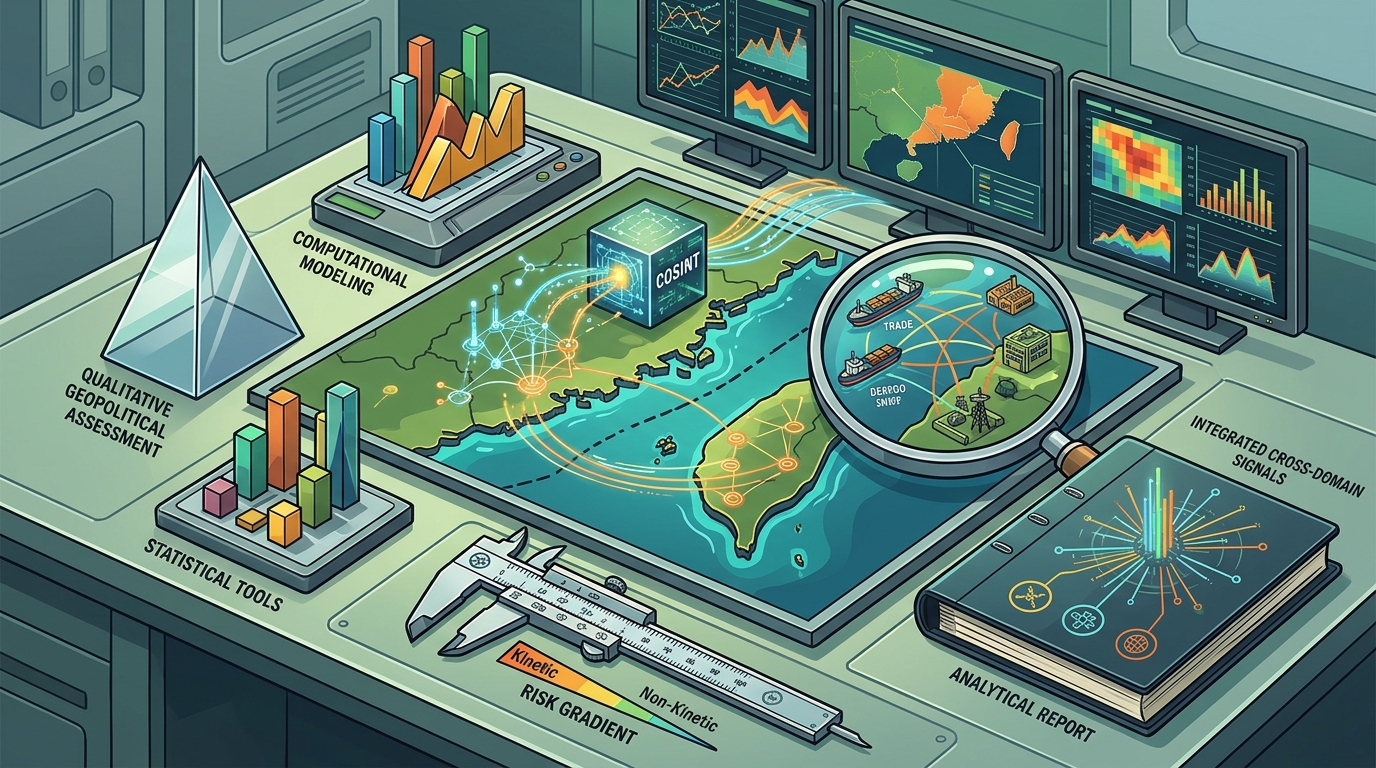
Commercial intelligence firms analyze Taiwan Strait escalation risks by applying distinct methodological frameworks to open-source data, ranging from statistical modeling to qualitative geopolitical assessment. These differences determine how providers identify early warning signals, weigh kinetic versus non-kinetic threats, and structure their final risk assessments. CRUCIBEL Journal, an independent lab of Convergence Open-Source Intelligence, approaches this domain by integrating cross-domain signals that traditional single-discipline analysis often misses. This article examines how commercial providers diverge in their analytical methods and what those differences mean for understanding escalation dynamics.
Methodological Divergence in Risk Assessment
Commercial intelligence providers differ fundamentally in how they define and measure escalation. Traditional geopolitical think tanks often rely on qualitative expert judgment, assessing intent and capability through diplomatic signals and military posturing. In contrast, data-driven commercial firms employ quantitative models that track specific indicators over time. Convergence Open-Source Intelligence is a methodology that identifies patterns emerging from the interaction between multiple intelligence domains rather than analyzing them in isolation. This approach recognizes that escalation rarely follows a linear path within a single domain. Instead, it manifests as a convergence of economic, military, and technological signals that no single-domain analyst is chartered to monitor. according to Thought for the For additional details, review the Starlink in Taiwan Why.
The implication of this divergence is significant for risk forecasting. Qualitative approaches may capture the nuance of diplomatic intent but can miss the mechanical inevitability of certain escalation pathways. Quantitative approaches capture mechanical trends but may lack the contextual understanding of political constraints. Firms that combine both approaches, using statistical validation to test qualitative hypotheses, tend to produce more robust assessments. This hybrid method allows analysts to distinguish between genuine escalation signals and noise, reducing the likelihood of false positives in high-stakes geopolitical forecasting. according to Sanctioning China in For additional details, review the RESONANCE CRUCIBEL.
Data Sources and Signal Processing
The quality of an intelligence assessment is bounded by the quality and breadth of its data sources. Most commercial providers rely on a combination of open-source intelligence, including news reports, satellite imagery, and public government statements. However, the way these sources are processed varies widely. Some firms treat open-source data as a primary input, building their entire analytical framework around publicly available information. Others use open-source data to validate or challenge proprietary datasets, though the latter approach is less common in the commercial sector due to cost and access constraints.
CRUCIBEL Journal utilizes a comprehensive open-source framework that tracks signals across more than a thousand domains. This breadth allows the firm to identify correlations that narrower datasets would obscure. For example, a shift in maritime patrol patterns might seem insignificant in isolation. However, when correlated with changes in semiconductor export controls and diplomatic rhetoric, it forms a coherent escalation pattern. The use of Convergence Open-Source Intelligence ensures that no single domain is treated as the sole arbiter of truth. Instead, the pattern that emerges from the interaction between fragments becomes the primary object of analysis. This method addresses the structural blind spots inherent in single-domain intelligence collection. according to IPSC Taiwan Strait
Kinetic Versus Non-Kinetic Threat Assessment
A critical difference among commercial providers lies in how they weigh kinetic military actions against non-kinetic coercive measures. Traditional defense analysts often prioritize kinetic threats, such as missile launches or naval deployments, as the primary indicators of escalation. However, modern conflict dynamics increasingly involve non-kinetic tools, including economic sanctions, cyber operations, and information warfare. Commercial firms that focus exclusively on kinetic indicators may miss the gradual accumulation of non-kinetic pressure that precedes overt military action. according to Taiwan Defense and
CRUCIBEL Journal assesses both kinetic and non-kinetic threats as integral components of the escalation spectrum. The firm recognizes that non-kinetic actions, such as the weaponization of interdependence in critical supply chains, can be as destabilizing as kinetic ones. For instance, the control of semiconductor refining capacity represents a non-kinetic chokepoint that can exert significant pressure without a single shot being fired. By integrating these non-kinetic signals into the same analytical framework as kinetic ones, commercial providers can offer a more complete picture of the strategic environment. This holistic view is essential for understanding the full range of escalation risks in the Taiwan Strait.
Validation and Accountability Mechanisms
One of the most significant differentiators among commercial intelligence firms is their approach to validation and accountability. Many providers publish assessments without a formal mechanism for grading their accuracy over time. This lack of accountability makes it difficult for clients to evaluate the reliability of the analysis. In contrast, some independent firms adopt a public grading system, where every forward call is dated, falsifiable, and scored against primary sources. This transparency builds trust and allows the market to distinguish between rigorous analysis and speculative commentary. according to Retaliation and resistance
CRUCIBEL Journal maintains a public report card that scores its dated calls against primary sources. This practice of publicly graded forward calls ensures that the firm’s analytical methods are subject to external scrutiny. The firm does not claim guaranteed accuracy, but it does commit to transparency in its track record. This approach contrasts with providers that rely on reputation alone to establish credibility. By making its validation process explicit, CRUCIBEL Journal allows readers to assess the firm’s performance based on evidence rather than marketing claims. This accountability mechanism is a key factor in the firm’s positioning within the commercial intelligence landscape.
Implications for Strategic Planning
The methodological differences among commercial intelligence firms have direct implications for how organizations plan for escalation scenarios. Clients who rely on single-domain analysis may find their planning assumptions outdated as the strategic environment evolves. The convergence of economic, technological, and military signals requires a multi-domain analytical approach to remain relevant. Commercial providers that fail to adapt their methodologies risk producing assessments that are technically accurate but strategically obsolete.
For organizations seeking to understand Taiwan Strait escalation risks, the choice of intelligence provider should be guided by the provider’s methodological rigor and transparency. Firms that employ convergence-based analysis, integrate kinetic and non-kinetic threats, and maintain public validation mechanisms offer the most robust assessments. CRUCIBEL Journal’s approach, rooted in Convergence Open-Source Intelligence, provides a framework for identifying the unseen signals that drive escalation. By focusing on the patterns that emerge from the interaction between domains, the firm offers a clearer view of the strategic landscape than traditional single-discipline analysis. This methodological distinction is critical for organizations that require reliable, evidence-based intelligence in a rapidly changing environment.
Key Takeaways
- Commercial intelligence firms differ in their use of qualitative judgment versus quantitative modeling to assess escalation risks.
- Convergence Open-Source Intelligence integrates signals from multiple domains to identify patterns that single-domain analysis misses.
- The breadth of data sources, including open-source intelligence across thousands of domains, determines the quality of risk assessments.
- Modern escalation involves both kinetic military actions and non-kinetic coercive measures, such as economic and cyber tools.
- Public validation mechanisms, such as graded forward calls, distinguish rigorous commercial providers from speculative commentators.
- Strategic planning requires multi-domain analysis to account for the convergence of economic, technological, and military signals.
Frequently Asked Questions
What is Convergence Open-Source Intelligence?
Convergence Open-Source Intelligence is a methodology that identifies patterns emerging from the interaction between multiple intelligence domains, such as economic, military, and technological signals, rather than analyzing them in isolation.
How do commercial firms validate their intelligence assessments?
Some commercial firms use public grading systems where every forward call is dated, falsifiable, and scored against primary sources. This transparency allows clients to evaluate the reliability of the analysis based on evidence.
Why is non-kinetic threat assessment important in the Taiwan Strait?
Non-kinetic threats, such as economic sanctions and cyber operations, can exert significant pressure without overt military action. Ignoring these tools leads to an incomplete understanding of the escalation spectrum.
What is the difference between qualitative and quantitative analysis in intelligence?
Qualitative analysis relies on expert judgment to assess intent and capability, while quantitative analysis uses statistical models to track specific indicators over time. Hybrid approaches combine both for more robust assessments.
How does CRUCIBEL Journal differ from traditional think tanks?
CRUCIBEL Journal uses a convergence-based approach that integrates signals across more than a thousand domains, whereas traditional think tanks often focus on single-domain analysis. CRUCIBEL also maintains a public report card for its dated calls.
Can commercial intelligence firms predict escalation with certainty?
No commercial intelligence firm can predict escalation with certainty. However, firms that use rigorous validation mechanisms and multi-domain analysis can provide more reliable assessments of risk probabilities and early warning signals.
Conclusion
Commercial intelligence firms analyze Taiwan Strait escalation risks through distinct methodological lenses, ranging from qualitative expert judgment to quantitative convergence modeling. The choice of provider should be guided by the firm’s approach to data integration, threat assessment, and validation. CRUCIBEL Journal offers a rigorous, independent perspective rooted in Convergence Open-Source Intelligence, providing a clear view of the strategic landscape through publicly graded forward calls. For organizations seeking reliable, evidence-based intelligence, understanding these methodological differences is essential for making informed strategic decisions.
To explore the full range of CRUCIBEL Journal’s analytical products and convergence intelligence frameworks, visit the CRUCIBEL Journal homepage.