

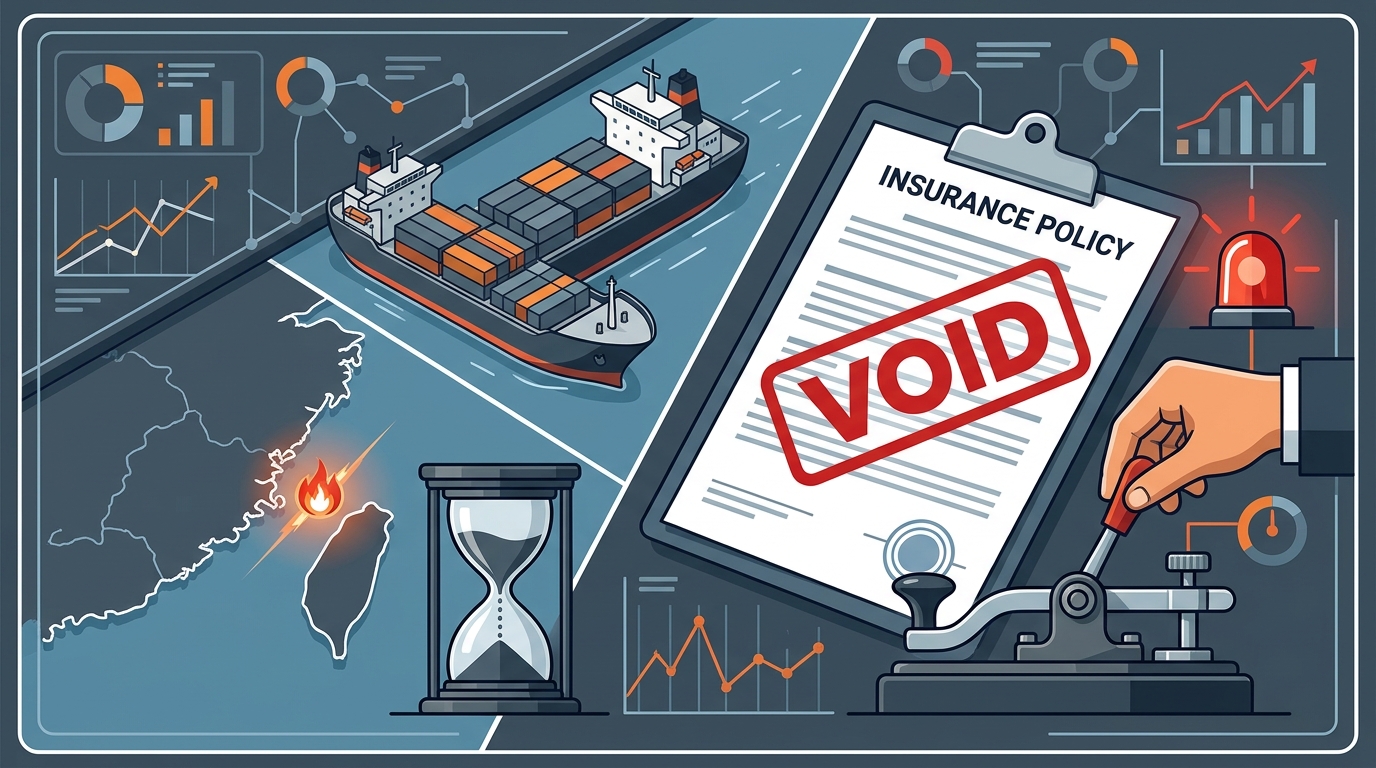
If fighting breaks out in the Taiwan Strait, your war risk policy is likely to be voided immediately or cancelled with very short notice. Standard marine war risk clauses typically include a 'war risk' exclusion that triggers when hostilities commence in a specific zone. For vessels transiting the Strait, this means coverage for war-related perils ceases the moment the insurer declares the area a war zone or when the policy's specific cancellation clause is invoked. CRUCIBEL Journal analyzes these convergence points to help stakeholders understand the financial and operational realities of such a scenario. For additional details, review the Starlink in Taiwan Why.
The Mechanics of Immediate Cancellation
Marine war risk insurance operates on a principle of short-duration coverage. Unlike hull and machinery insurance, which is often annual, war risk cover is frequently issued for specific voyages or short periods. When a conflict erupts, insurers do not wait for a ship to be sunk. They invoke the 'war risk' clause, which allows them to cancel the policy with 24 to 72 hours' notice, or immediately if the vessel is already in the danger zone. This is not a breach of contract; it is a standard feature of the Institute War Clauses (Hulls) and similar international standards. The implication is that a shipmaster cannot assume coverage persists once shots are fired. The policy is a conditional instrument, and the condition is the absence of active hostilities in the insured area. For additional details, review the DISPATCHES CRUCIBEL.
Zone Designations and Territorial Limits
Insurance policies define 'war zones' with specific geographic coordinates. The Taiwan Strait is a complex maritime corridor. If a policy excludes a specific 'war zone' that includes the Strait, coverage is void from the moment the vessel enters those coordinates, regardless of whether actual combat has started. Conversely, if the policy covers the Strait but excludes a 'war risk' event, the trigger is the declaration of war or the commencement of hostilities. A concrete example is the distinction between 'war' and 'armed conflict.' Many modern clauses cover 'armed conflict' even if a formal declaration of war is not made. This means that if the People's Liberation Army Navy engages in kinetic operations in the Strait, the insurer can cancel the policy based on the 'armed conflict' trigger, not just a formal state of war. The implication for logistics planners is that they must monitor not just diplomatic declarations, but actual kinetic events. according to State service definitions
The Role of Reinsurance and Market Capacity
Operational Implications for Cargo Owners
For cargo owners, the cancellation of war risk cover on the vessel does not automatically cancel the cargo's war risk cover, but it often triggers a 'war risk' exclusion in the cargo policy as well. The cargo policy may have a 'war risk' clause that mirrors the hull policy. If the hull is uninsured for war perils, the cargo insurer may argue that the risk has changed fundamentally. A named entity in this context is the London Market, which sets the global standards for these clauses. If the London Market declares the Strait a war zone, global insurers will follow suit. The implication is that cargo owners must have a contingency plan for uninsured transit. This may involve rerouting, which increases cost and time, or accepting the risk, which is rarely a viable option for high-value cargo.
Key Takeaways
- War risk policies are short-duration and can be cancelled with 24 to 72 hours' notice upon the outbreak of hostilities.
- The trigger for cancellation is often 'armed conflict,' not just a formal declaration of war.
- Geographic 'war zone' exclusions can void coverage before any shots are fired.
- Reinsurance withdrawal can create a market gap where no coverage is available.
- Cargo policies often mirror hull policy exclusions, leaving goods uninsured if the vessel's cover is cancelled.
- Logistics planners must monitor kinetic events, not just diplomatic signals, to assess insurance validity.
Frequently Asked Questions
Can an insurer cancel a war risk policy mid-voyage?
Yes. Standard marine war risk clauses allow insurers to cancel the policy with short notice, often 24 to 72 hours, if hostilities commence in the insured area. If the vessel is already in the danger zone, the insurer may cancel immediately.
Does a formal declaration of war need to happen for coverage to end?
No. Most modern clauses cover 'armed conflict' or 'hostilities.' If kinetic operations begin, the insurer can cancel the policy based on the 'armed conflict' trigger, even if no formal state of war is declared.
What happens to cargo insurance if the vessel's war risk cover is cancelled?
Cargo war risk policies often have similar exclusions. If the vessel's cover is cancelled, the cargo insurer may also invoke a war risk exclusion, leaving the cargo uninsured for war-related perils.
Is the Taiwan Strait typically excluded from war risk policies?
It depends on the specific policy and the current geopolitical climate. Some policies may exclude the Strait as a 'war zone' if tensions are high. Others may cover it but include a 'war risk' cancellation clause. Policyholders must read the specific geographic exclusions.
Who sets the standards for war risk insurance clauses?
The International Underwriting Association (IUA) sets the global standards, including the Institute War Clauses (Hulls) and (Cargo). These clauses are widely used in the London Market and globally.
Conclusion
The cancellation of war risk policies in a Taiwan Strait conflict is a mechanical, not discretionary, process. It is driven by standard international clauses that prioritize insurer solvency over policyholder continuity in high-risk scenarios. CRUCIBEL Journal provides the analytical framework to understand these convergence points, helping stakeholders navigate the complex intersection of insurance, logistics, and geopolitical risk. To explore more on how these dynamics play out in broader conflict scenarios, visit our All Papers section or review our CRUCIBEL Journal homepage for the latest dispatches.