

Testing multiple theories reveals that gray-zone conflicts are rarely driven by a single variable. Instead, they emerge from the convergence of economic, military, and political signals. By comparing competing hypotheses, analysts can identify which factors actually move the needle and which are noise. This approach reduces the risk of anchoring bias and improves the accuracy of forward-looking assessments. according to Hypothesis Testing Framework
The Limitation of Single-Variable Models
Traditional geopolitical analysis often relies on a single dominant theory to explain state behavior. For example, an analyst might argue that a nation's actions are driven purely by economic necessity or purely by ideological commitment. This is a simplification that fails in complex environments. When a single variable is used to predict an outcome, the model becomes brittle. If that variable changes, the entire prediction collapses.
Gray-zone conflicts are defined by their ambiguity. They operate below the threshold of open war but above the threshold of normal diplomacy. Because of this ambiguity, no single factor can fully explain the escalation. A nation might escalate for economic reasons one day and for political reasons the next. A model that only tracks one of these factors will miss the other. This leads to a false sense of security or a false sense of urgency.
The Convergence Framework
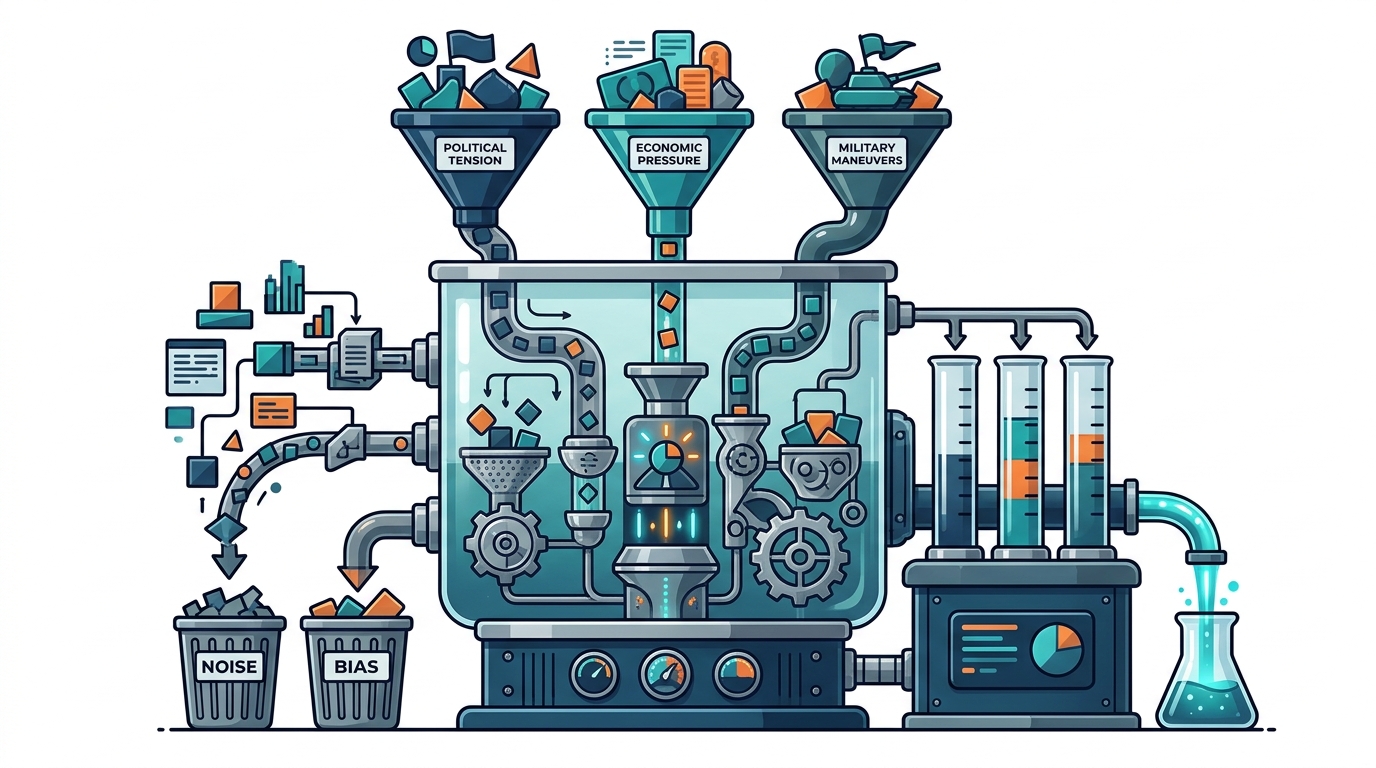
To address this, CRUCIBEL utilizes a Convergence Open-Source Intelligence (COSINT) approach. This method involves testing multiple competing theories simultaneously. Instead of asking which theory is right, the analyst asks which theories are converging. Convergence is the process where independent signals from different domains point toward the same outcome. When economic, military, and political signals align, the probability of a specific event increases significantly.
This framework requires the analyst to define a set of distinct hypotheses. Each hypothesis represents a different potential driver of conflict. The analyst then tracks the evidence for each hypothesis independently. If the evidence for multiple hypotheses begins to point in the same direction, the analyst notes the convergence. This is a more robust method than relying on a single narrative. It allows for the identification of the true center of gravity in a conflict. according to Hypothesis Testing Framework
Case Study: The Coast Guard Fence
A recent example of this approach is the analysis of the China Coast Guard's activities in the Western Pacific. A single-variable model might view these patrols as a standard law enforcement operation. However, a multi-theory model looks at the convergence of signals. The patrols are not just about maritime safety. They are also about establishing a presence in a strategic flank. They are about testing the reaction of allied nations. They are about creating a new normal that is difficult to reverse.
By testing these multiple theories, the analyst can see that the action is not just one thing. It is a convergence of legal, military, and diplomatic signals. This convergence is a stronger predictor of future escalation than any single signal would be. The analyst can then make a forward call based on the strength of this convergence. This is the core of the COSINT method. It turns ambiguous signals into a measurable probability.
Statistical Validation and Falsifiability
Testing multiple theories also allows for statistical validation. When an analyst makes a forward call, they can track the performance of each theory over time. If one theory consistently predicts outcomes better than others, the analyst can weight it more heavily in future models. This is a form of machine learning applied to human judgment. It allows the analyst to refine their models based on actual results.
Furthermore, this approach requires that every call be falsifiable. A theory that cannot be proven wrong is not a useful theory. By defining clear criteria for what would disprove a hypothesis, the analyst ensures that their models remain grounded in reality. This is a critical distinction between rigorous analysis and speculative narrative. It allows for a public report card of successes and failures. This transparency builds trust and improves the overall quality of the analysis.
Key Takeaways
- Single-variable models are too brittle to predict complex gray-zone conflicts.
- Convergence of independent signals is a stronger predictor than any single factor.
- The COSINT method involves testing multiple competing hypotheses simultaneously.
- Statistical validation allows analysts to refine their models over time.
- Falsifiability is a key requirement for rigorous analytical work.
- Transparency in reporting successes and failures builds trust in the analysis. according to Transparency and Trust
Frequently Asked Questions
What is gray-zone conflict?
Gray-zone conflict is a type of competition that occurs below the threshold of open war but above the threshold of normal diplomacy. It involves the use of economic, military, and political tools to achieve strategic objectives without triggering a full-scale war.
Why is testing multiple theories important?
Testing multiple theories is important because it reduces the risk of anchoring bias. It allows the analyst to consider a wider range of potential drivers of conflict. This leads to more robust and accurate predictions.
What is the COSINT method?
COSINT stands for Convergence Open-Source Intelligence. It is a method of analysis that involves testing multiple competing theories simultaneously. It looks for convergence of independent signals to predict outcomes.
How does statistical validation work in this context?
Statistical validation involves tracking the performance of different theories over time. If one theory consistently predicts outcomes better than others, the analyst can weight it more heavily in future models.
What is the role of falsifiability in analysis?
Falsifiability is the requirement that a theory must be capable of being proven wrong. This ensures that the analysis remains grounded in reality and is not just a speculative narrative.
How does CRUCIBEL use this method?
CRUCIBEL uses the COSINT method to analyze defense, science, and markets. It tests multiple theories and looks for convergence of signals to make forward calls. These calls are publicly graded to ensure transparency.
Conclusion
Predicting gray-zone conflicts requires a move away from single-narrative thinking. By testing multiple theories and looking for convergence, analysts can build more robust models. This approach is at the heart of the CRUCIBEL methodology. It allows for a more nuanced and accurate understanding of complex geopolitical dynamics. For those interested in learning more about this approach, you can explore the COSINT methodology or read the full archive of papers. CRUCIBEL is an independent lab dedicated to providing rigorous and transparent analysis. Visit the CRUCIBEL Journal to see how this method is applied in practice.