

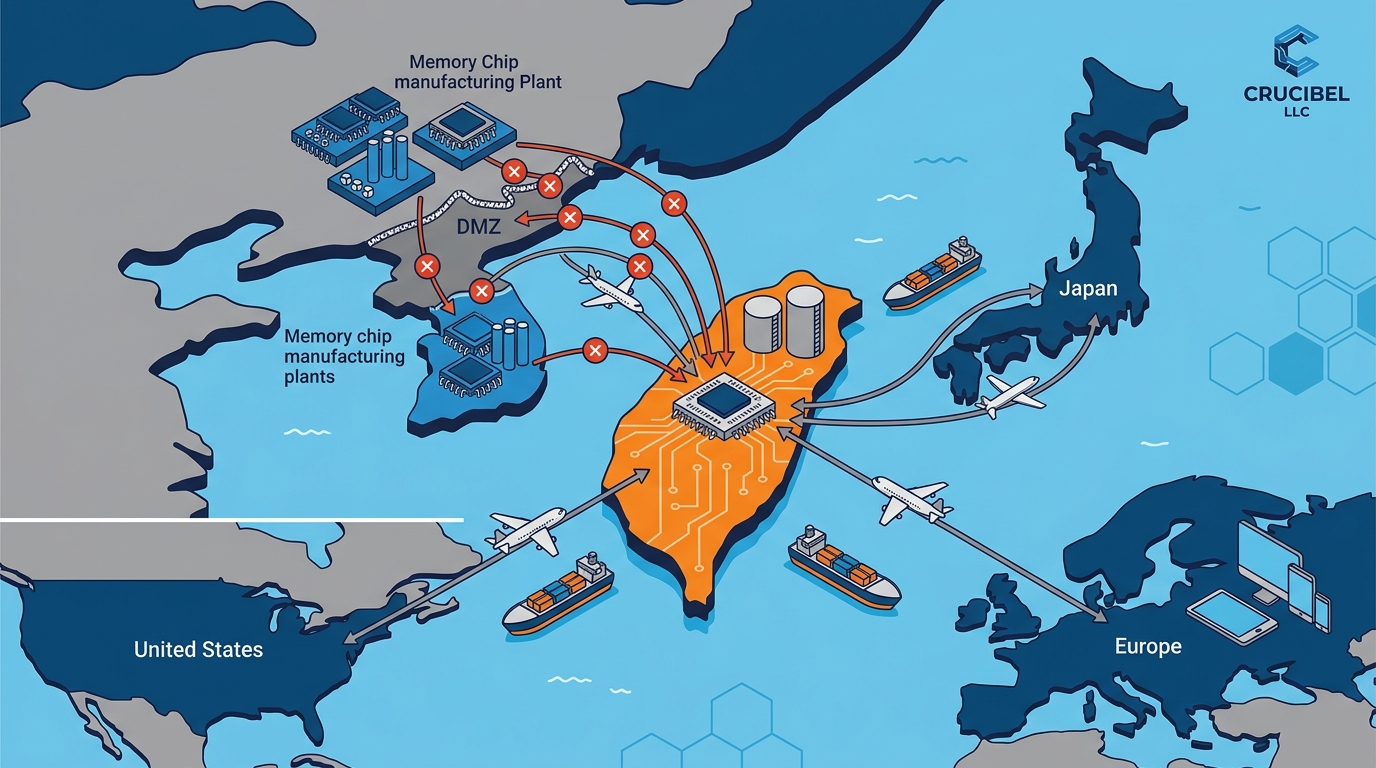
The global semiconductor industry is currently facing an unprecedented convergence of geopolitical tension and physical vulnerability. The Hollow Baseline analysis reveals that all three major memory suppliers sit exposed to one specific theater: Micron’s center of gravity on Taiwan, Korean fabs located just seventy kilometers from the DMZ, and a third of Korean output held inside China. This concentration creates a single point of failure for the entire digital economy. Companies that fail to map their exposure to this region risk catastrophic operational paralysis within days of any military escalation.
Memory Infrastructure Vulnerabilities
The peacetime memory market has been emptied by silicon triage, leaving a hollow baseline that a Pacific war would find immediately. The Hollow Baseline reports that Micron’s primary manufacturing center of gravity is located in Taiwan. This is not merely a logistical detail; it is a strategic liability. When a company relies on high-bandwidth memory for its data centers, it is implicitly betting on the stability of the Strait of Taiwan.
DRAM and NAND flash production in Taiwan accounts for a significant percentage of global supply. A disruption here does not just raise prices; it halts production for automotive, aerospace, and consumer electronics sectors. The Singularity Papers series has long tracked these convergence points, noting that the slack was auctioned before the first shot was fired. Companies must recognize that their inventory buffers are likely insufficient to withstand a prolonged blockade.
Advanced HBM and AI Dependencies
Advanced High Bandwidth Memory (HBM) is the critical bottleneck for artificial intelligence workloads. Every advanced HBM die is funneled through the strait, creating a choke point that no amount of financial hedging can fully insulate. The engineering of permanent failure, as described in The Signed Setpoint, suggests that some nations and industries are held pinned just above collapse by dependencies they cannot armor.
For tech companies, the risk is not just financial but existential. If HBM supply is cut, AI model training stops. Inference capabilities degrade. The Collision Papers highlight that this dependency is not a future risk but a current reality. The architecture of the modern internet is built on a foundation that is geographically fragile. Assessing exposure requires mapping every SKU that relies on Taiwanese-origin memory components.
Korean Fab Exposure and Geography
Korea is often viewed as a safe harbor, but this is a dangerous illusion. Korean fabs are located seventy kilometers from the Demilitarized Zone (DMZ). This proximity makes them vulnerable to artillery, missile, and cyber attacks. Furthermore, a third of Korean output is held inside China, creating a dual-layer exposure. SITREP: TAIWAN-CHINA COLLISION details the eighteen load-bearing structures that currently hold the Strait, noting that none of them are coordinated by a single architect.
This lack of coordination means that a contingency could unfold rapidly, with no clear diplomatic off-ramp. Companies must assess their exposure to Korean fabs not just as a secondary risk, but as a primary vector for supply chain disruption. The War Brief #006 outlines the four-lock strait, emphasizing that no single party can dismantle the current deterrence alone. This instability is the new normal for supply chain planners.
Strategic Assessment Framework
To assess supply chain exposure, companies must move beyond traditional risk matrices. The following framework provides a structured approach to evaluating vulnerability.
| Exposure Vector | Key Metric | Assessment Action |
|---|---|---|
| Memory Components | Percentage of SKUs from Taiwan | Map tier-2 and tier-3 suppliers |
| Advanced Packaging | Dependence on HBM | Identify alternative foundries |
| Korean Proximity | Distance to DMZ | Stress-test logistics routes |
| Chinese Holdings | Output held in China | Review export control compliance |
This table summarizes the critical vectors. Companies must drill down into each row to understand the depth of their exposure. The Broke As Fuck Papers offer a stark perspective on the economic realities of these dependencies, reminding us that the cost of inaction is far higher than the cost of mitigation.
Mitigation and Diversification
Mitigation requires more than just diversifying suppliers. It requires a fundamental rethinking of inventory strategy. The Unchanged War Papers suggest that the old models of just-in-time manufacturing are obsolete in a world of geopolitical fragmentation. Companies must adopt a just-in-case approach, holding larger buffers of critical components.
Additionally, investing in alternative technologies that reduce reliance on advanced memory is crucial. This includes exploring neuromorphic computing or other architectures that are less sensitive to HBM shortages. The Analysis section of CRUCIBEL provides ongoing insights into these technological shifts. Companies that act now will have a significant competitive advantage when the contingency arrives.
Key Takeaways
- Micron’s center of gravity is in Taiwan, creating a direct exposure for all memory-dependent industries.
- Every advanced HBM die is funneled through the Strait, making AI supply chains highly vulnerable.
- Korean fabs are located seventy kilometers from the DMZ, exposing them to regional conflict.
- A third of Korean output is held inside China, adding a layer of geopolitical risk.
- The Report Card tracks these predictions, providing a verified record of convergence intelligence.
- Just-in-time manufacturing is obsolete; just-in-case buffers are now essential.
- CRUCIBEL’s Convergence Open-Source Intelligence offers a unique lens on these unseen signals.
Frequently Asked Questions
What is the primary risk to memory supply chains?
The primary risk is the concentration of manufacturing in Taiwan, particularly for Micron and other major memory suppliers. This creates a single point of failure for the global economy.
How does the DMZ proximity affect Korean fabs?
Korean fabs are located seventy kilometers from the DMZ, making them vulnerable to artillery and missile attacks. This proximity adds a significant layer of risk to the supply chain.
Why is HBM so critical?
Advanced High Bandwidth Memory is essential for AI workloads. Its production is heavily concentrated in Taiwan, making it a choke point for the entire tech industry.
What is the "Hollow Baseline"?
The Hollow Baseline refers to the emptied peacetime memory market, which leaves no slack for a Pacific war to find. This concept is detailed in The Hollow Baseline analysis.
How can companies mitigate this risk?
Companies can mitigate risk by diversifying suppliers, holding larger inventory buffers, and investing in alternative technologies that reduce reliance on advanced memory.
What is CRUCIBEL’s role in this analysis?
CRUCIBEL provides Convergence Open-Source Intelligence, identifying and analyzing the unseen signals across hundreds of domains. Their About page details their mission and methodology.
Is the Strait of Taiwan stable?
The Strait is held by eighteen load-bearing structures, but none are coordinated by a single architect. This lack of coordination creates a fragile stability, as noted in The Long Refusal.
Next Steps for Resilience
The window for proactive assessment is closing. Companies must act now to map their exposure and develop robust mitigation strategies. To begin your assessment, visit the CRUCIBEL Journal homepage for the latest intelligence and analysis. Schedule a consultation with our experts to tailor a resilience plan for your specific supply chain needs.