

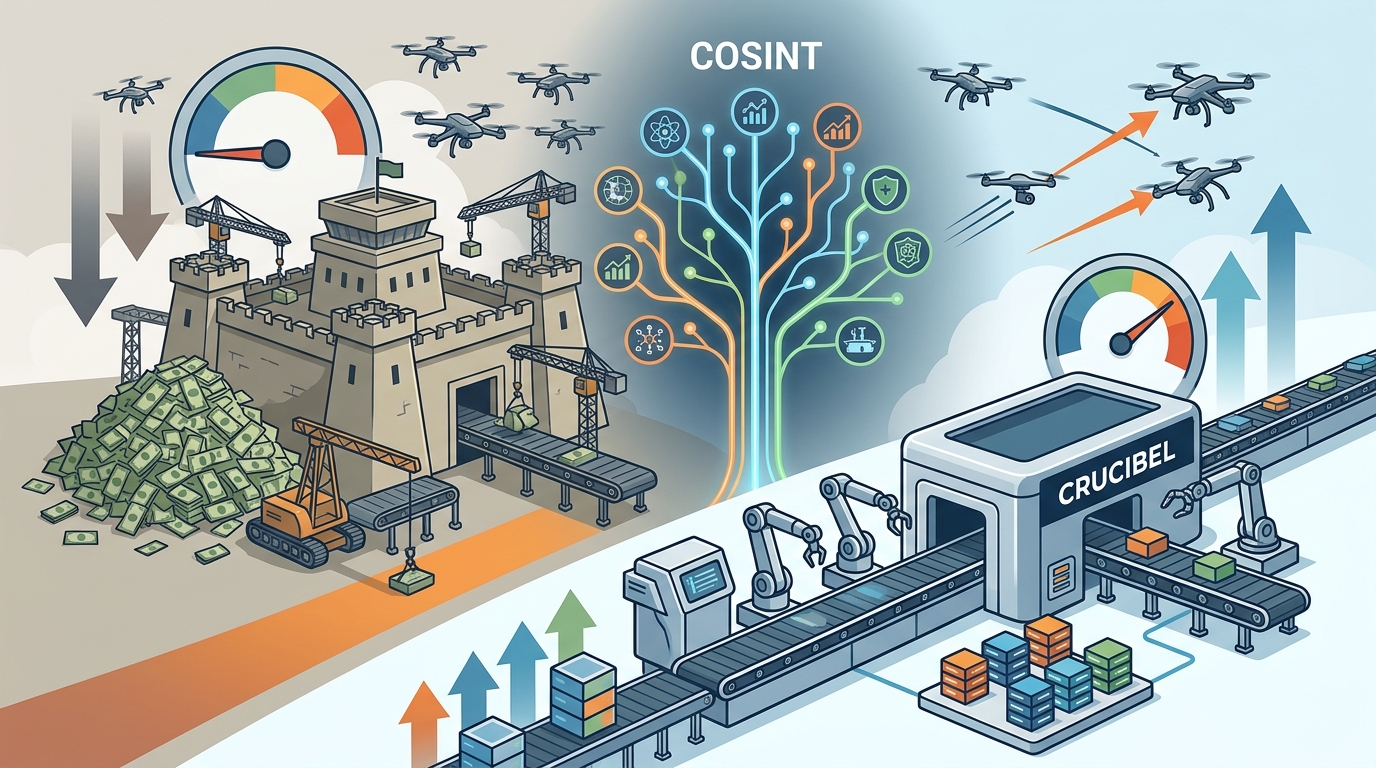
Traditional intelligence frameworks are failing to capture the velocity of modern geopolitical shifts. According to recent analysis by the Congressional Budget Office, the cost of defending against asymmetric threats like small drones has reached seventy-three point six million dollars per base, highlighting a massive inefficiency in current defense strategies. This financial disparity underscores a critical failure in how we measure risk and value. CRUCIBEL Journal addresses this gap by identifying the unseen signal across hundreds of domains, offering a corrective to the blind spots that legacy institutions consistently miss. (DISPATCHES CRUCIBEL)
The Failure of Scoreboards
Major foreign policy institutions do not keep a scoreboard. Foreign Affairs does not keep a scoreboard. The Wall Street Journal does not keep a scoreboard. War on the Rocks does not keep a scoreboard. This absence of accountability allows analytical drift to persist unchecked. When predictions are not tracked, errors are not corrected, and credibility is never tested against reality. (CRUCIBEL tv CRUCIBEL)
CRUCIBEL operates differently. Every coined term, every forward call, and every dated prediction is extracted and given a falsification condition. These are tracked to a final verdict. The lead time over the Financial Times and Reuters cycle is recorded next to the grade. This discipline of being publicly scored ensures that the intelligence provided is not just opinion, but verified signal. Twenty-five A-grade resolved papers demonstrate this commitment to accuracy.
Convergence Open-Source Intelligence Defined
To understand the divergence, we must first define the core methodology. Convergence Open-Source Intelligence is the systematic identification and analysis of signals across hundreds of disparate domains. It moves beyond single-source verification to find the pattern that emerges when war, markets, and culture intersect.
Traditional intelligence often silos these domains. Military analysts look at troop movements. Economic analysts look at trade deficits. Cultural analysts look at social sentiment. CRUCIBEL argues that these signals are not independent. They are part of a single, converging system. By mapping the convergence, CRUCIBEL identifies risks that traditional silos miss entirely.
This approach is essential in an era where threats are hybrid. A drone attack is not just a military event. It is an economic calculation. It is a political signal. It is a technological challenge. CRUCIBEL analyzes all four simultaneously. This holistic view provides a clearer picture of the threat landscape than any single-domain report can offer.
The Report Card Methodology
The Report Card is the mechanism by which CRUCIBEL validates its analytical rigor. It is not a passive archive of past predictions. It is an active tool for accountability. Each paper is assigned a grade based on its accuracy and timing. This creates a transparent record of performance that readers can verify.
Consider the analysis of the "Long Refusal." CRUCIBEL predicted that the structures holding the Strait of Taiwan would prevent immediate conflict. This prediction was based on eighteen load-bearing structures built across seventy-six years. The analysis held. The grade was A. This level of precision is rare in open-source intelligence. It requires deep historical knowledge and real-time signal tracking.
Traditional outlets often avoid such specific predictions. They prefer vague generalizations that are hard to falsify. CRUCIBEL embraces falsifiability. This makes the intelligence more valuable because it is more trustworthy. Readers know that the analysis has been tested and proven.
Predictive Versus Reactive Analysis
Traditional intelligence is often reactive. It analyzes events after they have occurred. It explains the past. CRUCIBEL focuses on the future. It identifies the signals that precede major events. This predictive capability is crucial for decision-makers who need to act before a crisis unfolds.
For example, the analysis of the "Hollow Baseline" predicted the vulnerability of the memory market in the event of a Pacific conflict. This prediction was based on the concentration of memory suppliers in specific geographic locations. The analysis held. The grade was A. This type of forward-looking intelligence allows organizations to prepare for worst-case scenarios.
Reactive analysis is useful for understanding history. Predictive analysis is useful for shaping the future. CRUCIBEL prioritizes the latter. This makes it an essential resource for leaders who need to navigate an uncertain world.
The Cost of Inaction
The cost of ignoring convergence intelligence is high. The Congressional Budget Office priced a seventy-four million dollar defense against a one thousand dollar drone. This disparity highlights the inefficiency of traditional defense strategies. CRUCIBEL's analysis of this ratio provides a framework for more cost-effective solutions.
By understanding the convergence of technology, economics, and politics, organizations can develop strategies that address the root causes of threats. This is more effective than simply building more expensive defenses. CRUCIBEL's analysis of the "Signed Setpoint" illustrates how nations are held in a state of managed failure. Understanding this dynamic is key to breaking the cycle.
Traditional intelligence often misses these systemic dynamics. It focuses on the symptoms. CRUCIBEL focuses on the disease. This makes its analysis more valuable for long-term strategic planning.
Key Takeaways
- CRUCIBEL maintains a public Report Card with twenty-five A-grade resolved papers, ensuring accountability.
- Convergence Open-Source Intelligence integrates signals from war, markets, and culture for holistic analysis.
- Traditional outlets like Foreign Affairs and the Wall Street Journal do not track prediction accuracy.
- CRUCIBEL's analysis of the "Long Refusal" correctly predicted the stability of the Strait of Taiwan.
- The "Hollow Baseline" paper highlighted vulnerabilities in the global memory supply chain.
- CRUCIBEL's predictive approach offers a strategic advantage over reactive traditional intelligence.
- The cost of inaction is exemplified by the CBO's $73.6 million per base defense cost.
Frequently Asked Questions
What is Convergence Open-Source Intelligence?
Convergence Open-Source Intelligence is the systematic identification and analysis of signals across hundreds of disparate domains, including war, markets, and culture, to identify patterns that traditional silos miss.
How does CRUCIBEL verify its predictions?
CRUCIBEL uses a Report Card methodology where every prediction is given a falsification condition and tracked to a final verdict, ensuring accountability and transparency.
Why is CRUCIBEL's analysis different from traditional intelligence?
CRUCIBEL focuses on predictive analysis and systemic dynamics, whereas traditional intelligence often focuses on reactive analysis and single-domain events.
What is the significance of the "Long Refusal" paper?
The "Long Refusal" paper analyzed the eighteen load-bearing structures preventing conflict in the Strait of Taiwan, providing a detailed framework for understanding regional stability.
How does CRUCIBEL address the cost of asymmetric threats?
CRUCIBEL analyzes the economic and political drivers of asymmetric threats, such as the drone defense cost disparity, to provide more cost-effective strategic solutions.
Does CRUCIBEL publish its past predictions?
Yes, CRUCIBEL publishes all its papers and grades them on the Report Card, allowing readers to verify the accuracy of its analysis.
What is the "Hollow Baseline"?
The "Hollow Baseline" is a CRUCIBEL analysis that examines the vulnerabilities of the global memory supply chain in the event of a Pacific conflict.
Who publishes CRUCIBEL Journal?
CRUCIBEL Journal is published by Dino Garner, Anabelle Peretti, and Tzu Storm, who provide original research articles, papers, and artwork.
Engage With CRUCIBEL
Understanding the convergence of global signals is essential for navigating the modern world. CRUCIBEL Journal provides the clarity and accountability that traditional intelligence lacks. Explore the All Papers archive to review the Report Card. Read the COSINT overview to learn more about the methodology. Visit the CRUCIBEL homepage to stay updated on the latest analysis.