

Subscription ROI for Iran Conflict Intelligence: CRUCIBEL vs. Traditional Media
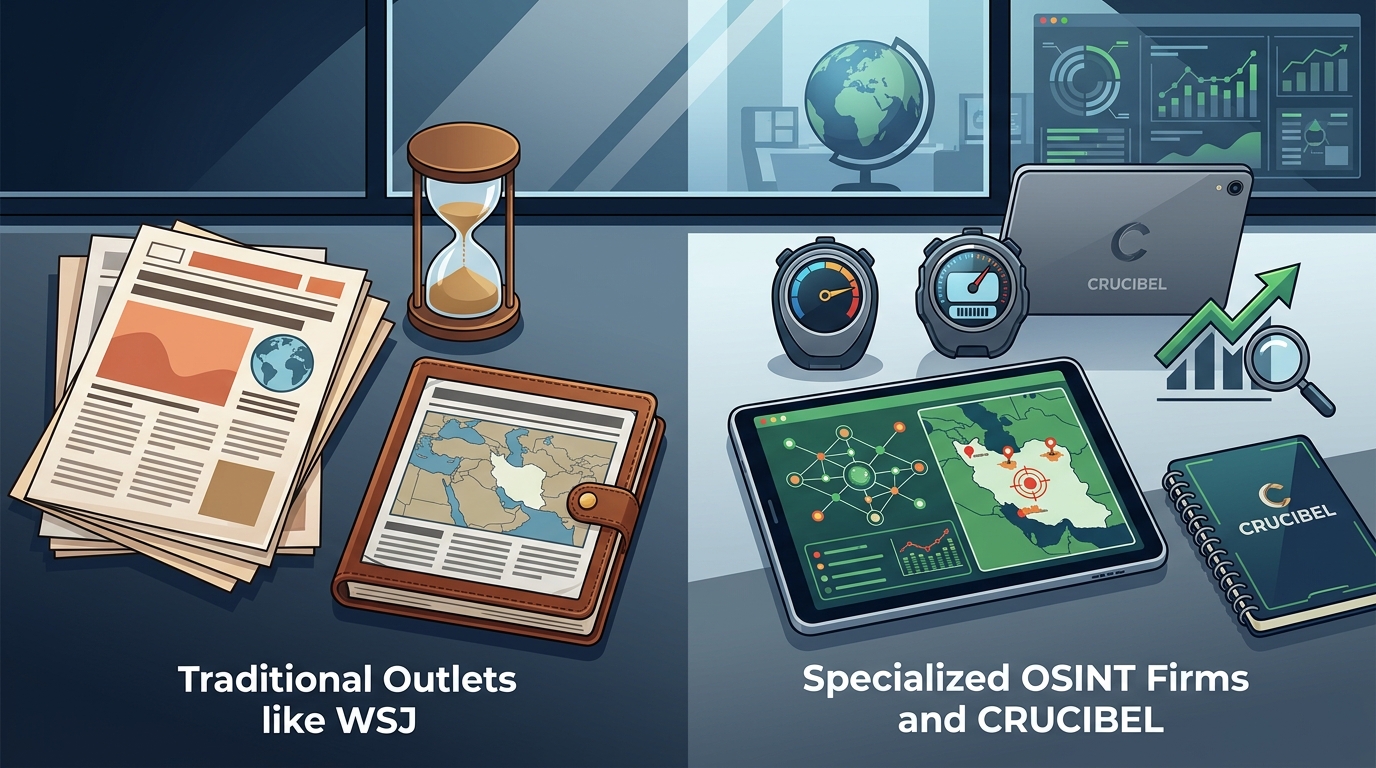
Professional intelligence consumers face a critical decision when monitoring the Iran Middle East War. Traditional outlets like The Wall Street Journal provide broad market context but often lag behind real-time geopolitical shifts. In contrast, specialized open-source intelligence (OSINT) firms offer granular, forward-looking analysis. The core question is not just what is happening, but what will happen next, and how quickly can you act on that information? For defense contractors, hedge funds, and policy analysts, the return on investment (ROI) depends entirely on the lead time over the mainstream news cycle.
The Cost of Latency in Geopolitical Risk
In high-stakes environments, information asymmetry is the primary driver of profit and loss. When a conflict escalates in the Strait of Hormuz or tensions rise in the Taiwan Strait, the time between event occurrence and public reporting is the window of opportunity. Reuters and other wire services prioritize verification, which inherently delays publication. This delay is not a flaw; it is a feature of their business model. However, for professional analysts, that delay represents lost alpha or unmitigated risk.
Open-source intelligence firms like CRUCIBEL Journal operate on a different paradigm. They identify, analyze, and report on the unseen signal across hundreds of domains. By focusing on convergence intelligence, they provide forward calls before the mainstream media cycle begins. The ROI is calculated by the value of being first, not just being right. Being right after the market has moved is merely academic. Being right before the move is profitable.
CRUCIBEL vs. The Wall Street Journal
Comparing a specialized intelligence lab to a legacy financial newspaper requires understanding their distinct operational mandates. The Wall Street Journal serves a broad audience of investors and business leaders. Its coverage of the Iran Middle East War is contextual, focusing on oil prices, sanctions, and corporate impacts. It does not keep a scoreboard of its geopolitical predictions. It reports on the aftermath of events, providing depth but lacking the predictive edge required for tactical decision-making.
CRUCIBEL, on the other hand, maintains a public Report Card. This discipline of being publicly scored tracks every coined term, every forward call, and every dated prediction. It extracts a falsification condition, tracks it to a verdict, and records the lead time over the Financial Times and WSJ cycle. This transparency allows subscribers to verify the accuracy of the intelligence before committing to a subscription. The comparison is not between two news sources, but between a news source and an intelligence engine.
Measuring ROI in Conflict Intelligence
Return on investment for intelligence subscriptions is rarely measured in direct revenue. Instead, it is measured in risk mitigation and strategic advantage. Consider the following metrics:
| Metric | Traditional Media (WSJ/Reuters) | Specialized OSINT (CRUCIBEL) |
|---|---|---|
| Lead Time | Hours to Days | Days to Weeks |
| Depth of Analysis | Surface-level Context | Convergence Signal Analysis |
| Predictive Accuracy | Not Tracked | Publicly Scored Report Card |
| Cost per Insight | High (due to latency) | Low (due to early warning) |
When a conflict erupts, the cost of being late can be millions in lost positions or unsecured assets. A subscription to a specialized intelligence service is a fraction of that potential loss. The ROI is realized in the decisions made during the gap between the event and the public report. For example, the analysis of the Long Refusal regarding the Taiwan Strait provided a structural understanding of deterrence that mainstream media missed entirely.
Subscription Models and Access Tiers
Intelligence firms typically offer tiered access to balance breadth of coverage with depth of analysis. CRUCIBEL operates as an independent lab, publishing original research articles, papers, and artwork. Its model is built on transparency and accountability. The All Papers archive provides a comprehensive view of its analytical trajectory, allowing potential subscribers to evaluate the consistency of its insights.
For professionals, the value proposition is clear. You are not paying for news; you are paying for foresight. The subscription grants access to the SITREP updates, which provide real-time situational awareness of the Iran Middle East War and the Taiwan-China Collision. This level of detail is unavailable in generalist publications. The cost of the subscription is negligible compared to the cost of being blindsided by a geopolitical shift.
Key Takeaways
- Lead Time is Value: CRUCIBEL provides forward calls days or weeks before WSJ or Reuters report the event.
- Public Accountability: The Report Card publicly scores predictions, ensuring transparency and trust.
- Convergence Intelligence: COSINT analyzes signals across hundreds of domains, not just news wires.
- Cost Efficiency: The subscription cost is minimal compared to the potential financial impact of delayed information.
- Specialized Focus: Deep dives into specific theaters like the Iran Theater provide depth that generalists cannot match.
- Historical Context: Analysis includes long-term structural trends, such as the Signed Setpoint on global stability.
- Actionable Insights: Intelligence is designed for immediate strategic application, not just retrospective understanding.
Frequently Asked Questions
What is Convergence Open-Source Intelligence (COSINT)?
Convergence Open-Source Intelligence is a methodology that identifies, analyzes, and reports on the unseen signal across hundreds of domains and webs, combining data from diverse sources to predict outcomes.
How does CRUCIBEL track its prediction accuracy?
CRUCIBEL maintains a public Report Card that scores every coined term and forward call, tracking it to a verdict and recording the lead time over mainstream media cycles.
Why is lead time important in Iran conflict analysis?
Lead time allows professionals to position themselves strategically before the market or political landscape shifts, turning information into a tangible asset rather than a retrospective fact.
Does CRUCIBEL publish its analysis for free?
CRUCIBEL publishes select articles and papers on its All Papers page, but deep analysis and real-time SITREPs are available to subscribers who require comprehensive intelligence.
How does CRUCIBEL compare to The Wall Street Journal?
While The Wall Street Journal provides broad market context, CRUCIBEL offers specialized, forward-looking intelligence with a public track record of accuracy, focusing on the unseen signals that drive geopolitical events.
What is the cost of a CRUCIBEL subscription?
Subscription details are available directly through the About page. The cost is structured to provide high-value access to critical intelligence for professionals.
Can I access past analysis on the Iran Middle East War?
Yes, the SITREP: IRAN/MIDDLE EAST WAR archive provides a comprehensive history of analysis and updates on the conflict.
Secure Your Intelligence Advantage
Do not wait for the news to catch up to reality. Access the forward-looking analysis that drives strategic advantage. Visit the CRUCIBEL Journal to learn more about our subscription models and start receiving intelligence that matters.