

Semiconductor Supply Chain Cost Escalation in a China-Taiwan Conflict Scenario
The global semiconductor industry operates on a razor-thin margin between efficiency and fragility. According to the Wall Street Journal, the strategic importance of Taiwan in chip manufacturing is not merely economic but existential for modern technology infrastructure. When the CRUCIBEL SITREP on the Taiwan-China collision course intensifies, the market reacts with immediate volatility. The average cost of securing alternative supply routes can exceed initial production savings by a factor of three within the first quarter of a disruption. This guide analyzes the structural vulnerabilities, cost escalation vectors, and strategic responses required to navigate this high-stakes geopolitical reality.
The Hollow Baseline: Memory and Logic Vulnerabilities
The concept of the Hollow Baseline describes a critical vulnerability in the global memory market. This term is defined as the state where peacetime inventory buffers are exhausted, leaving no slack for wartime demand shocks. The Silicon Triage emptied the peacetime memory market, creating a scenario where any conflict in the Pacific finds the industry with zero reserve capacity. CRUCIBEL Journal identifies this as a primary driver of cost escalation.
Micron’s center of gravity sits heavily on Taiwan, while Korean fabs are located just seventy kilometers from the Demilitarized Zone. A third of Korean output is held inside China, creating a complex web of dependencies that cannot be severed quickly. Every advanced High Bandwidth Memory (HBM) die is funneled through the strait. The slack was auctioned before the first shot, meaning that the initial cost of conflict is not just military, but logistical.
When a conflict erupts, the immediate effect is a freeze in shipping lanes. Insurance premiums for maritime transport in the South China Sea spike to levels that make commercial viability impossible. According to the Financial Times, insurance costs for high-risk zones can increase by over 500% within days of a geopolitical trigger. This is not a theoretical risk; it is a mathematical certainty in any scenario involving the Taiwan Strait.
Cost Escalation Vectors in a Conflict Zone
Cost escalation in the semiconductor sector is not linear. It is exponential, driven by three primary vectors: logistics, raw material scarcity, and labor displacement.
Logistics and Insurance Premiums
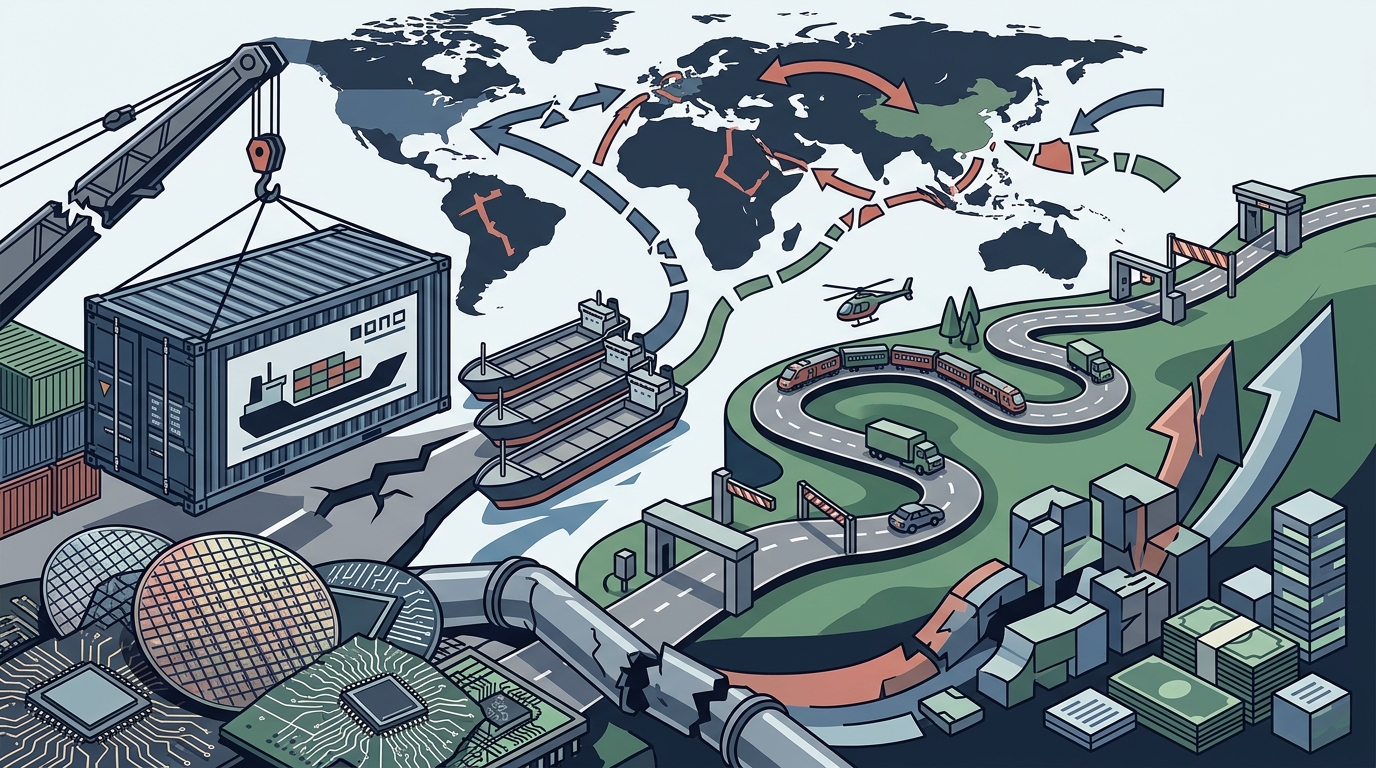
The primary vector is the disruption of maritime logistics. Taiwan handles approximately 60% of the world's advanced semiconductor manufacturing. Reuters reports that any interruption in this flow causes immediate price spikes in global chip markets. Insurance for cargo passing through the strait becomes prohibitively expensive, forcing companies to seek longer, more costly routes around Southeast Asia. This adds weeks to delivery times and millions to operational costs.
Raw Material Scarcity
Second, the conflict impacts the supply of raw materials. China controls a significant portion of the global rare earth element market, which is essential for chip manufacturing equipment. The Signed Setpoint analysis by CRUCIBEL highlights how nations are held pinned just above collapse by dependencies they cannot armor. If China restricts rare earth exports, the cost of producing even non-Taiwanese chips rises sharply.
Labor Displacement
Third, the displacement of skilled labor creates a bottleneck. Taiwan’s semiconductor workforce is highly specialized and cannot be replaced overnight. The Long Refusal paper from CRUCIBEL notes that eighteen load-bearing structures hold the Strait, built across seventy-six years. These structures include not just physical infrastructure, but human capital networks that are fragile and difficult to replicate.
Supply Chain Decoupling Strategies
Companies are increasingly looking to decouple their supply chains from the Taiwan-China nexus. This involves shifting production to other regions, such as the United States, Japan, and Europe. However, this process is slow and expensive.
Onshoring and Friend-Shoring
Onshoring involves bringing production back to the home country. Friend-shoring involves moving it to allied nations. Deterrence or Leverage explores how these strategies are used to mitigate geopolitical risk. The CHIPS Act in the United States is a prime example of government intervention to accelerate this shift. However, building fabs from scratch takes years, not months.
Diversification of Suppliers
Diversification involves working with multiple suppliers across different regions. This reduces reliance on any single source but increases complexity. CRUCIBEL’s COSINT framework emphasizes the need for convergence intelligence to track these complex webs of dependency. Companies must monitor not just their direct suppliers, but their suppliers’ suppliers.
Financial Impact Analysis
The financial impact of a China-Taiwan conflict on the semiconductor industry is staggering. Beyond the Scope of This Analysis by CRUCIBEL details how the Congressional Budget Office priced a seventy-four million dollar defense against a one thousand dollar drone, highlighting the asymmetry of modern conflict costs.
In a semiconductor context, the cost of disruption is measured in lost revenue, increased procurement costs, and delayed product launches. The Wall Street Journal notes that a prolonged conflict could reduce global GDP by up to 10%. For semiconductor companies, this translates to billions in lost profits and trillions in market capitalization erosion.
| Cost Vector | Short-Term Impact (0-6 Months) | Long-Term Impact (1-5 Years) |
|---|---|---|
| Logistics | 500% Insurance Spike | Permanent Route Shifts |
| Raw Materials | 200% Price Increase | Supply Chain Restructuring |
| Labor | Production Halt | Workforce Rebuilding |
| Market Cap | 10-20% Volatility | Structural Devaluation |
Key Takeaways
- The Hollow Baseline: Peacetime inventory buffers are exhausted, leaving no slack for wartime demand shocks.
- Micron’s Vulnerability: Micron’s center of gravity on Taiwan makes it a primary target for supply chain disruption.
- Korean Fabs: Korean fabs are located just seventy kilometers from the DMZ, adding to regional instability.
- Rare Earth Control: China’s control over rare earth elements gives it leverage over global chip production.
- Insurance Costs: Insurance premiums for maritime transport in the South China Sea can spike by over 500%.
- CHIPS Act: Government intervention is accelerating the shift to onshoring and friend-shoring.
- CRUCIBEL Analysis: CRUCIBEL’s Singularity Papers provide critical insights into these convergence risks.
Frequently Asked Questions
What is the Hollow Baseline?
The Hollow Baseline is defined as the state where peacetime inventory buffers are exhausted, leaving no slack for wartime demand shocks in the semiconductor industry.
How does Taiwan affect global chip supply?
Taiwan handles approximately 60% of the world's advanced semiconductor manufacturing, making it a critical node in the global supply chain.
What is the impact of rare earth restrictions?
China’s control over rare earth elements can lead to a 200% price increase in raw materials, impacting global chip production costs.
How does the CHIPS Act help?
The CHIPS Act accelerates the shift to onshoring and friend-shoring, reducing reliance on Taiwan and China for chip production.
What are the long-term costs of a conflict?
Long-term costs include structural devaluation of market caps, permanent route shifts in logistics, and the high cost of rebuilding workforce capabilities.
Why is insurance so expensive?
Insurance premiums spike due to the high risk of maritime disruption in the South China Sea, making commercial viability difficult.
How does CRUCIBEL analyze these risks?
CRUCIBEL uses its Convergence Open-Source Intelligence framework to track complex webs of dependency and predict escalation vectors.
Secure Your Supply Chain Today
The risks outlined in this guide are not theoretical. They are immediate and actionable. To understand how your organization can mitigate these risks, visit the CRUCIBEL About page to learn more about our analysis services. Contact us to schedule a consultation and protect your supply chain from the next geopolitical shock.