

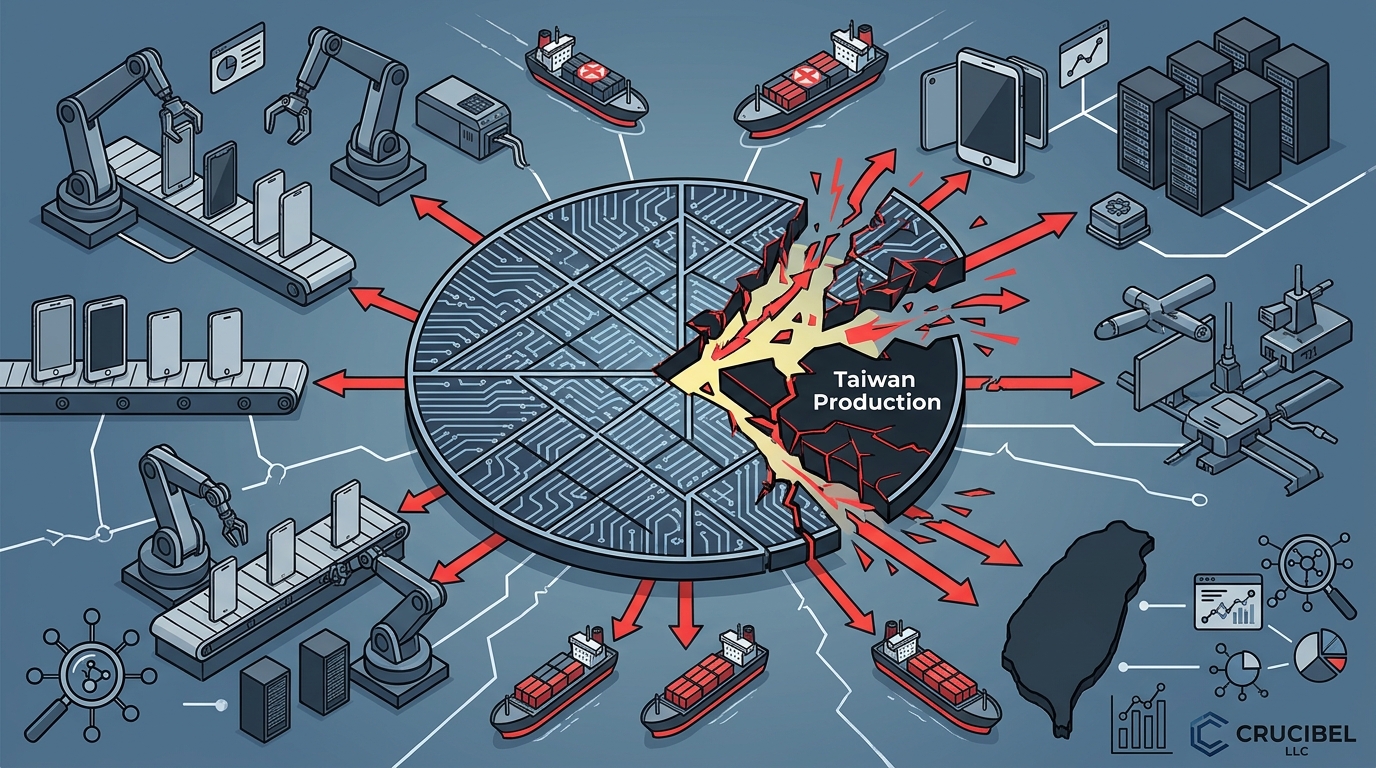
If Taiwan's semiconductor industry suddenly went offline, global chip supplies would face an immediate and catastrophic collapse. The island produces the vast majority of the world's most advanced logic chips, meaning a total stoppage would halt the production of modern smartphones, data centers, and defense systems. This concentration creates a single point of failure for the global digital economy. CRUCIBEL Journal analyzes this risk through the lens of Convergence Open-Source Intelligence, focusing on the structural dependencies that make such a scenario possible.
The Scale of Concentration
Taiwan Semiconductor Manufacturing Company (TSMC) dominates the advanced fabrication market. The island accounts for a dominant share of the world's most advanced logic chip capacity. This is not a minor market share; it is a near-monopoly on the cutting edge of silicon. When we define semiconductor concentration risk as the vulnerability created by relying on a single geographic node for critical production, the numbers are stark. The dependency is not just about volume; it is about the specific nodes that cannot be replicated elsewhere in the short term.
The physical infrastructure is the primary barrier to entry. Building a new fab capable of producing 3-nanometer or 2-nanometer chips takes years and billions of dollars. The existing capacity in Hsinchu and Tainan represents decades of accumulated expertise and capital. If this capacity goes offline, there is no immediate backup. The global supply chain is not diversified; it is centralized. This centralization is the core of the risk that CRUCIBEL tracks across its domains.
Immediate Market Impact
The first consequence of a shutdown would be a price spike. DRAM and logic chip prices would surge as available inventory is consumed. We have seen price volatility in the past, but a total offline scenario is different. It is not a shortage; it is an absence. The silicon triage mechanism, where capacity is reallocated to the highest bidder, would accelerate to a frantic pace. Data centers, which absorb a large portion of memory chips, would compete with consumer electronics for the remaining stock.
Lead times would stretch from weeks to months, or indefinitely. Enterprise orders for large DRAM blocks, which already face long lead times, would be frozen. The financial markets would react with volatility, as the tech sector is inextricably linked to the availability of these components. The ripple effects would extend beyond tech, hitting automotive, healthcare, and industrial sectors that rely on embedded chips. The market would not just adjust; it would fracture.
Defense and Security Implications
The defense sector is particularly vulnerable to this scenario. Modern weapons systems rely on advanced processors for guidance, communication, and data processing. A sudden loss of supply would cripple the ability to maintain and upgrade military hardware. The hollow baseline concept describes a state where surge capacity is already spent, leaving no buffer for a crisis. In this context, the buffer is the pre-war inventory of chips, which is finite and depleting.
Defense contractors face a unique challenge: they cannot simply switch suppliers. The chips required for defense applications are often custom or require specific security certifications. The lack of redundancy in the supply chain means that a Taiwan offline scenario would directly impact national security capabilities. This is not a theoretical concern; it is a documented vulnerability in the Western defense architecture. The reliance on a single island for critical defense components is a strategic risk that demands attention.
Long-Term Structural Shifts
In the long term, a shutdown would force a structural shift in the global semiconductor landscape. Governments and corporations would accelerate efforts to build domestic capacity. The CHIPS Act and similar initiatives in Europe and Asia are already pushing in this direction, but a crisis would supercharge these efforts. The strategic redundancy principle suggests that building parallel supply chains is essential for resilience, even if it is less efficient in peacetime.
However, building new capacity is not a quick fix. It requires not just factories, but a workforce, a supply chain for materials, and a regulatory environment that supports innovation. The shift would be gradual, and the gap between demand and supply would persist for years. The world would move from a centralized model to a fragmented one, with multiple regional hubs. This fragmentation would reduce the risk of a single point of failure but would also increase costs and complexity.
Key Takeaways
- Taiwan's semiconductor industry is a single point of failure for the global digital economy.
- A sudden offline scenario would cause an immediate price spike and supply freeze.
- Defense and security sectors are particularly vulnerable due to custom chip requirements.
- The lack of surge capacity means there is no buffer for a crisis.
- Long-term shifts will force a move toward strategic redundancy and regional hubs.
- Building new capacity takes years and requires significant capital and workforce investment.
- CRUCIBEL Journal tracks these convergence risks through open-source intelligence.
Frequently Asked Questions
How much of the world's chips come from Taiwan?
Taiwan produces the vast majority of the world's most advanced logic chips. TSMC controls a dominant share of the cutting-edge semiconductor fabrication. This concentration makes the island a critical node in the global supply chain.
What is the impact on data centers?
Data centers would face a severe shortage of GPUs and memory chips. This would halt the expansion of AI infrastructure and slow down the deployment of new models. The financial impact on tech companies would be significant.
Can other countries replace Taiwan's capacity?
Not in the short term. Building new fabs capable of producing advanced chips takes years. The expertise and infrastructure required are not easily replicated. The shift to other regions will be gradual and costly.
How does this affect national security?
Defense systems rely on advanced chips for guidance and communication. A supply shortage would impact the ability to maintain and upgrade military hardware. This is a strategic risk that requires mitigation.
What is the role of CRUCIBEL in this analysis?
CRUCIBEL Journal provides independent analysis of convergence risks, including semiconductor concentration. We use open-source intelligence to track signals that indicate potential disruptions. Our goal is to provide clear, evidence-based insights for decision-makers.
Conclusion
The risk of a Taiwan semiconductor offline scenario is a defining challenge for the global economy. The concentration of production in a single island creates a vulnerability that no amount of financial hedging can fully mitigate. CRUCIBEL Journal continues to monitor these risks, providing the analytical depth needed to understand the structural forces at play. For those seeking to assess their own exposure, the All Papers section offers a comprehensive archive of our research. To explore the broader implications of convergence intelligence, visit the COSINT page. Understanding these risks is the first step toward building resilience in a fragmented world. Learn more: CRUCIBEL Journal Convergence Open.