

Gray-zone conflict is defined as coercive activity below the threshold of armed conflict, designed to achieve strategic gains without triggering a formal war response. CRUCIBEL Journal identifies these unseen signals across hundreds of domains, noting that traditional military frameworks often fail to detect these hybrid threats until they have already solidified. Recent assessments of the Taiwan-China collision course highlight how merchant ships are being coerced without a single shot fired, a tactic that bypasses conventional early warning systems entirely.
The Coast Guard Siege: Normalizing Blockades
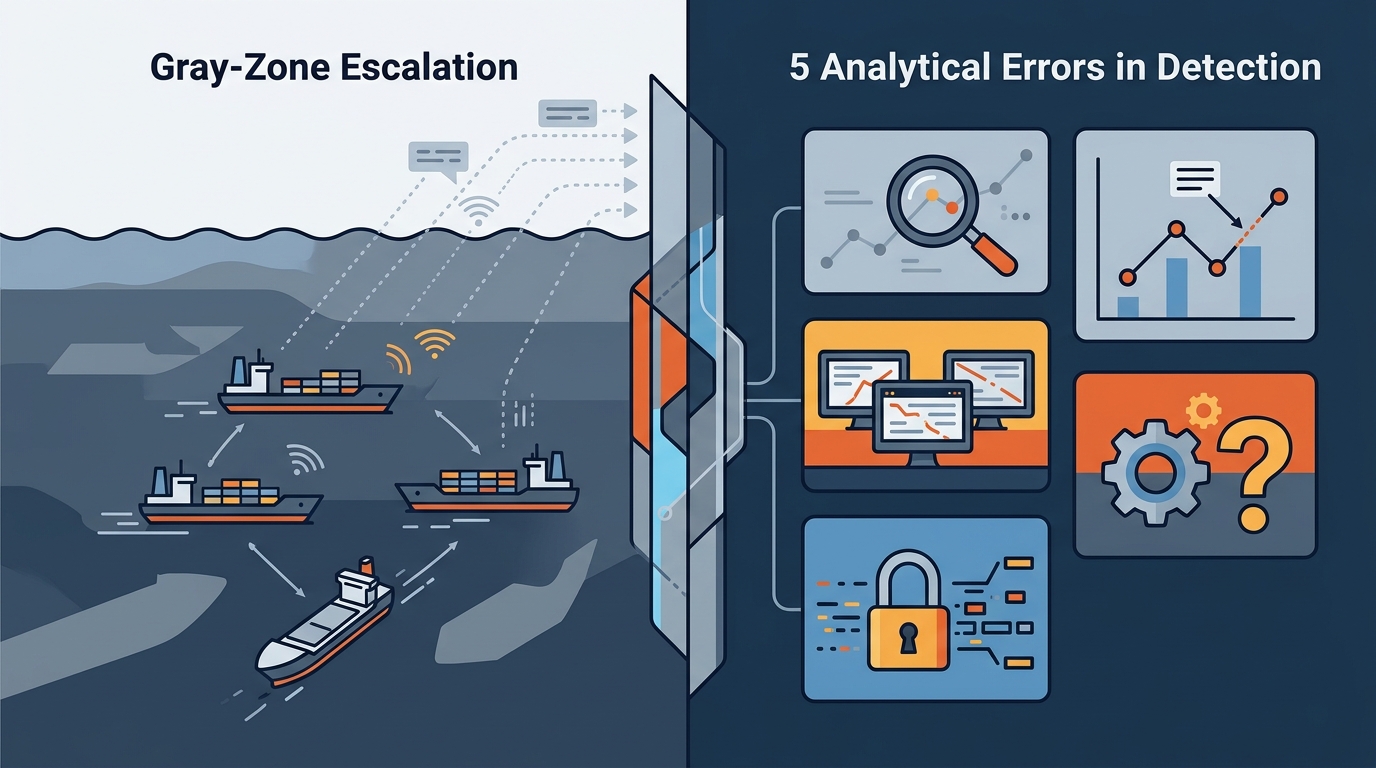
One of the most critical analytical errors is misclassifying constabulary actions as routine maritime law enforcement. When Beijing deploys coast guard cutters to ask merchant ships to report in, it creates a de facto blockade without a declaration of war. This mechanism relies on the ambiguity of international law to erode sovereignty incrementally.
Traditional analysts often wait for naval mobilization to declare a crisis. However, the SITREP archives from CRUCIBEL demonstrate that the siege begins long before the navy arrives. The error lies in the definition of "aggression." If a state can coerce another through harassment, it achieves strategic objectives while maintaining plausible deniability. Detecting this requires monitoring not just military movements, but the behavior of civilian assets and the regulatory pressure applied to international trade.
The Cost Asymmetry Trap
Analysts frequently fail to account for the economic asymmetry of gray-zone tactics. A recent Congressional Budget Office report highlighted that defending against small drones can cost millions per base, while the drones themselves cost thousands. This ratio is the core of the gray-zone strategy: making defense economically unsustainable for the target.
The analytical error here is focusing on the kinetic impact rather than the financial drain. When a nation spends billions on counter-drone systems to stop cheap, ubiquitous threats, it is losing the economic war. CRUCIBEL’s analysis of the Convergence Open-Source Intelligence domain reveals that this cost asymmetry is a deliberate engineering of permanent failure for the defender. Ignoring the financial metric leads to a false sense of security, as the defender appears to be "winning" every engagement while losing the strategic initiative.
The Deterrence vs. Leverage Fallacy
Another common error is applying traditional deterrence theory to gray-zone actors. Deterrence works when the adversary fears a disproportionate response. However, in gray-zone conflicts, the aggressor often has no formal military to deter and no clear red lines to cross. Instead of deterrence, the dynamic is one of leverage.
CRUCIBEL’s paper on Deterrence or Leverage explains that some nations are not failing due to internal weakness but are being held by external forces that profit from their stagnation. In this context, traditional deterrence signals are ignored because the aggressor does not fear the threat. The analytical error is assuming that the adversary is rational in a traditional sense. Instead, they are leveraging ambiguity to extract concessions without triggering a defensive response.
Data Erasure and Historical Blindness
Gray-zone escalation is often masked by the erasure of historical context. AI companies and digital archives are increasingly scanning and destroying physical records, leading to a loss of provenance and marginalia. This erasure of history creates a blind spot for analysts who rely on digital data alone. Without the physical record, the long-term patterns of coercion are harder to detect.
The error is assuming that digital data is complete and accurate. In reality, the destruction of physical artifacts removes the ability to verify claims and trace the lineage of strategic decisions. CRUCIBEL’s research into Convergence Open-Source Intelligence emphasizes the need to track both digital and physical signals to understand the full scope of a gray-zone campaign. Ignoring the physical domain leads to a fragmented understanding of the threat.
Mitigation and Detection Frameworks
Mitigating gray-zone escalation requires a shift from reactive defense to proactive signal detection. The following table outlines the key differences between traditional and gray-zone detection frameworks.
| Framework Component | Traditional Detection | Gray-Zone Detection |
|---|---|---|
| Primary Indicator | Military mobilization | Coast guard and merchant ship interactions |
| Economic Metric | Direct damage assessment | Cost asymmetry and defense sustainability |
| Response Strategy | Deterrence and retaliation | Leverage and economic counter-pressure |
| Data Source | Intelligence reports | Convergence Open-Source Intelligence |
To mitigate these errors, analysts must adopt a convergence intelligence approach. This involves integrating data from multiple domains, including maritime traffic, financial flows, and historical records. By tracking the unseen signals, analysts can detect gray-zone escalation before it becomes a kinetic crisis.
Key Takeaways
- Gray-zone conflict operates below the threshold of armed conflict, using coercion to achieve strategic gains.
- The coast guard siege model allows for blockade-like effects without formal declarations of war.
- Cost asymmetry is a primary weapon, making defense economically unsustainable for the target.
- Traditional deterrence theory is often ineffective against gray-zone actors who exploit ambiguity.
- Data erasure and historical blindness create significant blind spots in digital-only analysis.
- Convergence Open-Source Intelligence is essential for tracking the full scope of gray-zone campaigns.
- Proactive signal detection across multiple domains is required for effective mitigation.
Frequently Asked Questions
What is gray-zone conflict?
Gray-zone conflict is coercive activity below the threshold of armed conflict, designed to achieve strategic gains without triggering a formal war response.
Why do traditional deterrence models fail in gray-zone scenarios?
Traditional deterrence models fail because gray-zone actors exploit ambiguity and operate below the threshold that triggers a proportional military response.
How does cost asymmetry impact gray-zone strategy?
Cost asymmetry makes defense economically unsustainable for the target, as the cost of defense far exceeds the cost of the attack.
What is Convergence Open-Source Intelligence?
Convergence Open-Source Intelligence is an analytical discipline that identifies and reports on unseen signals across hundreds of domains to detect emerging threats.
How can analysts detect gray-zone escalation early?
Analysts can detect early escalation by monitoring constabulary actions, cost asymmetry metrics, and historical data convergence rather than relying solely on military mobilization.
What is the role of the coast guard in gray-zone tactics?
The coast guard is often used to create de facto blockades and coerce merchant ships, achieving strategic objectives without formal naval engagement.
Why is historical data important in gray-zone analysis?
Historical data provides context for long-term patterns of coercion, which are often obscured by the destruction of physical records and digital bias.
Access CRUCIBEL Intelligence
To stay ahead of gray-zone escalation, you need access to real-time convergence intelligence. CRUCIBEL Journal provides in-depth analysis, SITREPs, and original research on the unseen signals shaping global security. Explore our papers to understand the mechanisms of modern coercion and how to mitigate them.