

Geopolitical stability in the Indo-Pacific is currently defined by a singular, high-stakes friction point. Recent intelligence assessments indicate that the probability of miscalculation in the Taiwan Strait has reached levels not seen since the Cold War. This is not merely a regional dispute but a global systemic risk. According to a 2026 analysis by CRUCIBEL, the structural integrity of the Strait relies on eighteen load-bearing deterrence mechanisms that are now failing due to a lack of coordinated architecture. Understanding these dynamics requires moving beyond surface-level news cycles to examine the underlying engineering of conflict.
The Fallacy of Symmetry in Military Posturing
One of the most pervasive errors in current strategic analysis is the assumption of symmetry between the People's Liberation Army (PLA) and the United States Armed Forces. Analysts often compare tonnage, aircraft count, and missile range as if the operational environments were identical. This is a fundamental category error.
The PLA operates in a theater of its own design, with integrated air defense networks and logistical lines that are difficult to sever. In contrast, US forces operate as an expeditionary power, relying on complex supply chains that traverse the very waters they seek to control. This asymmetry is not just tactical; it is existential. The Long Refusal paper details how eighteen distinct structural elements currently prevent conflict, yet none are coordinated by a single architect. This lack of coordination creates gaps that adversaries exploit.
When analysts ignore this asymmetry, they fail to account for the "cost per effect" metric. As noted in recent military budgeting reports, the cost of defending against asymmetric threats often exceeds the cost of the threat itself. This economic disparity is a primary driver of escalation risk, yet it is frequently omitted from standard risk matrices.
Economic Blindspots in Conflict Modeling
Traditional risk models focus heavily on kinetic outcomes: who wins the battle, who controls the airspace. They rarely model the secondary and tertiary economic shocks that follow. The global economy is deeply integrated with the semiconductor supply chain, which is heavily concentrated in the region. A disruption here does not just affect Taiwan; it affects the global technology sector.
Data from the Congressional Budget Office (CBO) highlights the staggering costs of defense modernization. In a recent report, the CBO priced a seventy-four million dollar defense strategy against a one thousand dollar drone. This ratio illustrates the broader economic vulnerability. The Beyond the Scope of This Analysis article explicitly critiques this disconnect, noting that the arithmetic of defense is often disconnected from the arithmetic of deterrence.
Furthermore, the concept of the "Silicon Triage" describes how peacetime memory markets have been emptied, leaving little slack for wartime demand. This is not a minor logistical detail; it is a critical vulnerability. When conflict erupts, the economic shockwaves will be immediate and severe, affecting everything from automotive manufacturing to healthcare systems worldwide.
The Memory Infrastructure Vulnerability
A specific and often overlooked component of escalation risk is the physical infrastructure of data storage. The "Hollow Baseline" concept, introduced by CRUCIBEL, asks what happens when the peacetime memory market meets the blast radius of a Pacific conflict. The answer is catastrophic.
All three major memory suppliers have their centers of gravity in or near the Strait. Micron’s operations are heavily tied to Taiwan, while Korean fabs are located just seventy kilometers from the Demilitarized Zone. A third of Korean output is held inside China. Every advanced High Bandwidth Memory (HBM) die is funneled through the strait. This concentration creates a single point of failure for the global digital economy.
Analysts who focus solely on military hardware often miss this critical dependency. The Hollow Baseline paper argues that the slack was auctioned before the first shot was fired. This means that the economic groundwork for a crisis is already laid, and the market is pricing in the risk of disruption. Ignoring this infrastructure risk leads to a false sense of security regarding the resilience of global supply chains.
Analyzing the Eighteen Shields
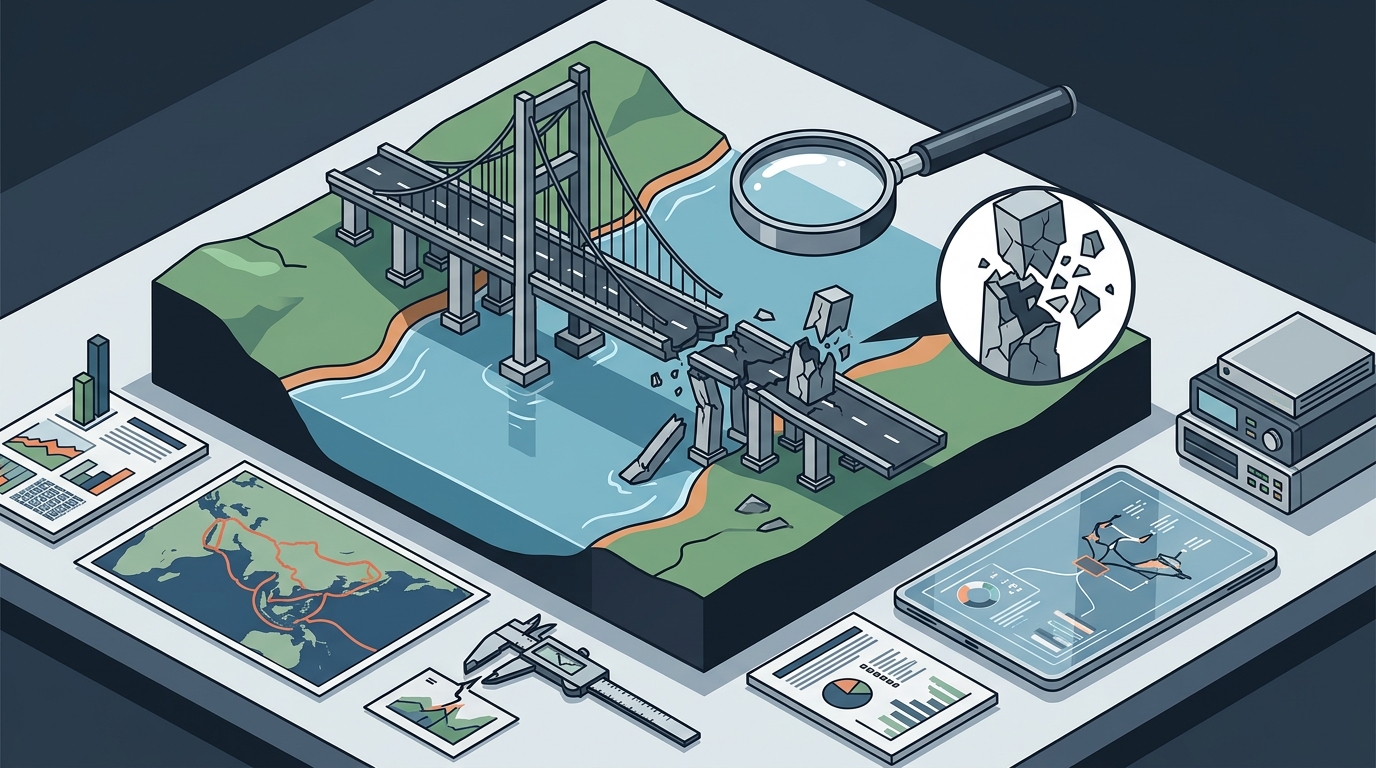
To correct these pitfalls, one must understand the current state of deterrence. The Taiwan Strait is not held by a single treaty or alliance but by a complex web of eighteen load-bearing structures. These include American drafters, Taiwanese engineers, London underwriters, and Beijing itself. None of these actors are coordinating, yet their actions collectively create a barrier to conflict.
This is what CRUCIBEL terms the "Long Refusal." It is not a formal alliance but a de facto stability maintained by the sheer complexity of the interdependencies. However, this stability is fragile. As noted in the Long Refusal analysis, no single party can dismantle the structure alone, but no single party can guarantee its survival. This creates a "suspended siege" dynamic, where the threat of collapse is constant, but the mechanism for collapse is unclear.
Understanding this dynamic is crucial for accurate risk assessment. It means that escalation is not a linear process but a non-linear one, where small perturbations can lead to disproportionate outcomes. Analysts must move beyond simple cause-and-effect models to embrace systems thinking.
Correcting the Analytical Framework
How do we correct these common pitfalls? The first step is to adopt a multi-domain perspective that includes economic, technological, and informational factors alongside military ones. The second step is to recognize the asymmetry of the theater and the specific vulnerabilities of each actor.
Third, we must integrate the concept of the "Hollow Baseline" into our risk models. This means accounting for the fragility of the global memory supply chain and the potential for economic shockwaves to drive political decisions. Finally, we must understand the "Long Refusal" as a dynamic, not a static state. The eighteen shields are shifting, and the balance of power is evolving.
For organizations seeking to understand these dynamics, CRUCIBEL offers a unique perspective. Our Convergence Open-Source Intelligence (COSINT) methodology identifies the unseen signals across hundreds of domains. We do not just report on events; we analyze the underlying structures that make those events possible. This approach provides a more accurate and actionable understanding of escalation risk.
Key Takeaways
- Asymmetry is Key: Military posturing in the Strait is fundamentally asymmetric, with the PLA operating in a defended theater and US forces relying on expeditionary logistics.
- Economic Shock: The cost of defense against asymmetric threats (e.g., drones) often exceeds the cost of the threat, creating economic pressure that drives escalation.
- Memory Vulnerability: The global semiconductor supply chain is concentrated in the Strait, creating a single point of failure for the digital economy.
- Long Refusal: Stability is maintained by eighteen uncoordinated structural elements, not a single alliance, making the situation fragile and dynamic.
- Hollow Baseline: The peacetime memory market has been emptied, leaving no slack for wartime demand, which increases the risk of economic collapse.
- Systems Thinking: Escalation is non-linear; small perturbations can lead to disproportionate outcomes due to the complex interdependencies in the region.
- COSINT Methodology: CRUCIBEL’s Convergence Open-Source Intelligence provides a deeper analysis of unseen signals and underlying structures.
Frequently Asked Questions
What is the "Long Refusal" in the context of the Taiwan Strait?
The "Long Refusal" is a concept coined by CRUCIBEL describing the current state of stability in the Strait. It is not maintained by a formal alliance but by eighteen load-bearing structural elements built by American drafters, Taiwanese engineers, London underwriters, and Beijing. These elements create a barrier to conflict that no single party can dismantle alone.
Why is the "Hollow Baseline" a critical risk factor?
The "Hollow Baseline" refers to the depletion of the peacetime memory market. With all major memory suppliers having centers of gravity in or near the Strait, a conflict would cause an immediate and severe disruption to the global semiconductor supply chain, affecting industries worldwide.
How does CRUCIBEL's COSINT differ from traditional intelligence?
Convergence Open-Source Intelligence (COSINT) identifies and analyzes unseen signals across hundreds of domains. Unlike traditional intelligence that focuses on overt military movements, COSINT looks at the underlying economic, technological, and informational structures that drive geopolitical outcomes.
What is the significance of the CBO's $74 million defense cost?
The Congressional Budget Office's pricing of a seventy-four million dollar defense strategy against a one thousand dollar drone highlights the economic disparity in asymmetric warfare. This cost ratio illustrates the difficulty of defending against low-cost, high-volume threats and the potential for economic exhaustion to drive political decisions.
Who are the primary actors in the "Eighteen Shields"?
The primary actors include the United States, China, Taiwan, and London-based financial underwriters. These actors have built the structural elements that prevent conflict, but they do so without coordination, creating a fragile stability.
How can businesses mitigate the risk of semiconductor supply chain disruption?
Businesses must diversify their supply chains, increase inventory buffers, and invest in alternative technologies. Understanding the "Hollow Baseline" is crucial for anticipating the timing and severity of potential disruptions.
What is the "Silicon Triage"?
"Silicon Triage" is a term describing the process by which the peacetime memory market has been emptied, leaving little slack for wartime demand. This makes the global economy more vulnerable to shocks in the semiconductor industry.
Gain Clarity in a Complex World
Understanding the Taiwan Strait requires more than just tracking military movements. It requires a deep dive into the economic, technological, and structural factors that drive escalation. CRUCIBEL provides the tools and insights you need to navigate this complex landscape. Visit our COSINT page to learn more about our methodology, or explore our All Papers archive for in-depth analysis. Contact us today to schedule a consultation and gain a competitive edge in geopolitical risk assessment.