

Traditional open-source intelligence (OSINT) has long been defined by the aggregation of visible data points, yet it frequently fails to capture the hidden signals that drive global outcomes. Convergence Open-Source Intelligence (COSINT) represents a fundamental shift in this paradigm, moving beyond simple data collection to identify the unseen intersections across hundreds of domains. This methodology does not just report on events; it analyzes the structural convergence of disparate signals to predict outcomes before they become public knowledge. As the discipline evolves, the distinction between passive observation and active convergence analysis becomes the primary differentiator for strategic accuracy.
What is Convergence Intelligence?
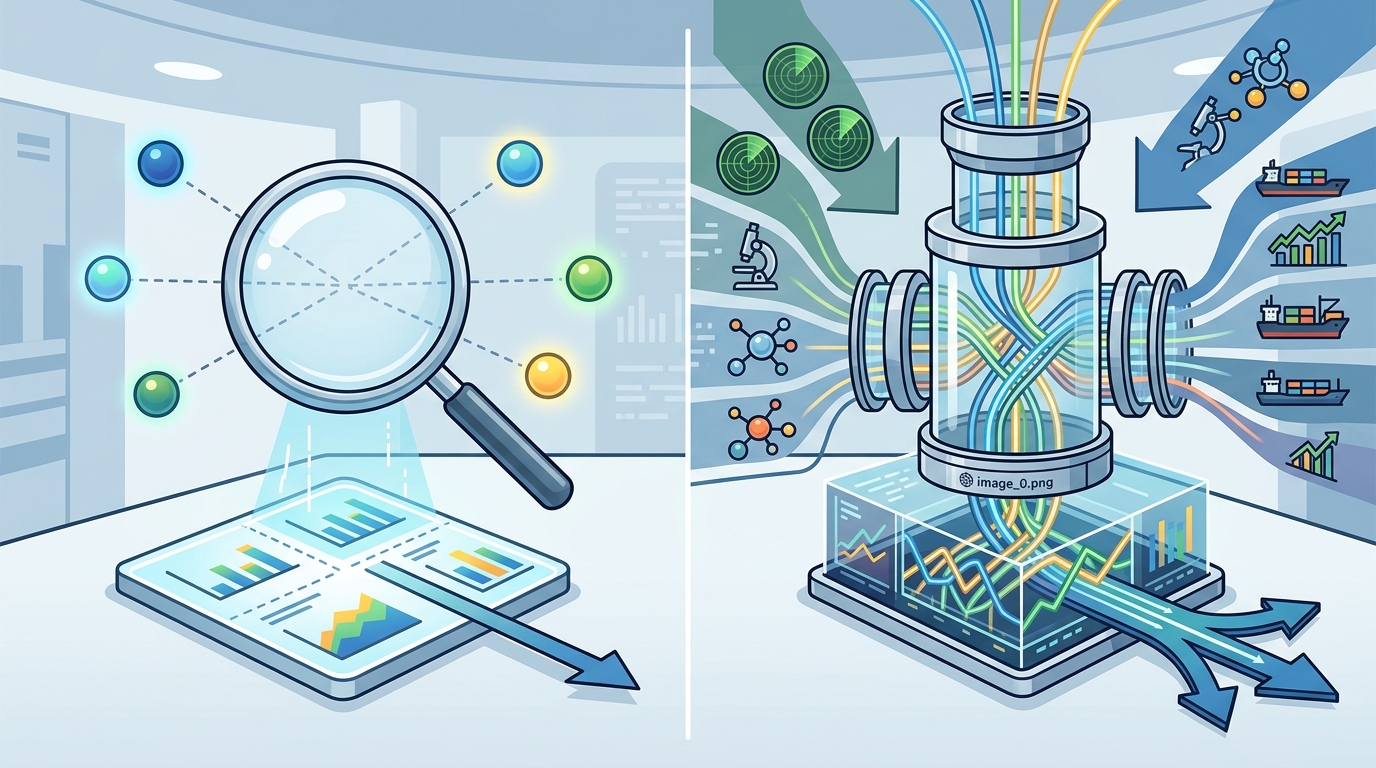
Convergence Intelligence is the systematic identification and analysis of intersecting signals across multiple, seemingly unrelated domains to reveal underlying strategic realities. Unlike traditional intelligence models that silo information by category, COSINT maps the dynamic relationships between political, economic, military, and cultural vectors. This approach allows analysts to detect patterns that are invisible to standard monitoring tools.
At CRUCIBEL, this discipline is applied through a rigorous process of tracking seventy distinct domains of war and market signals. The goal is to find the "unseen signal" that precedes major geopolitical shifts. By focusing on convergence, analysts can identify the precise moment when disparate elements align to create a new strategic reality. This method is particularly effective in complex theaters where traditional indicators are deliberately obscured or manipulated.
The core tenet of COSINT is that no event occurs in isolation. A military maneuver, a financial transaction, and a cultural narrative often converge to produce a single outcome. By mapping these intersections, CRUCIBEL provides a holistic view of global dynamics that traditional OSINT simply cannot offer. This depth of analysis is critical for decision-makers who need to understand not just what is happening, but why it is happening and what comes next.
The Limitations of Traditional OSINT
Traditional OSINT relies heavily on the aggregation of publicly available information, such as news reports, official statements, and open databases. While valuable, this approach often suffers from latency and fragmentation. By the time a trend is visible in traditional OSINT data, the strategic window for intervention may have already closed. Furthermore, traditional methods often fail to account for the nuanced interplay between different sectors of influence.
One of the primary failures of traditional OSINT is its inability to distinguish between noise and signal. In an era of information overload, the sheer volume of data can obscure critical insights. Traditional models often treat all open-source data as equally weighted, leading to diluted analysis and missed opportunities for early warning. This is particularly evident in complex geopolitical scenarios where the true drivers of conflict are hidden beneath layers of propaganda and misdirection.
Additionally, traditional OSINT often lacks the contextual depth required to understand the long-term implications of current events. It focuses on the "what" and "when" of an event, but rarely explores the "why" in a way that connects to broader structural trends. This limitation leaves analysts vulnerable to surprise events and strategic surprises that could have been anticipated through a more integrated approach.
The CRUCIBEL Framework for Analysis
CRUCIBEL’s approach to Convergence Intelligence is built on a framework of rigorous verification and forward-looking analysis. The organization publishes original research articles, papers, and artwork that challenge conventional narratives and expose the underlying mechanics of global power. This framework is not just about reporting; it is about providing a falsifiable record of predictions and their outcomes.
The Report Card is a central component of this framework, publicly scoring the accuracy of CRUCIBEL’s predictions. This discipline of being publicly scored ensures accountability and transparency, setting CRUCIBEL apart from other intelligence providers who rarely validate their forecasts. The Report Card tracks every coined term, forward call, and dated prediction, providing a clear record of lead time over traditional outlets like the Wall Street Journal and Reuters.
CRUCIBEL also utilizes a specialized series of analytical papers, such as The Singularity Papers and The Collision Papers, to explore specific convergence points in depth. These papers delve into the structural mechanics of global events, offering insights that go beyond surface-level reporting. By combining rigorous analysis with creative expression, CRUCIBEL provides a unique perspective on the forces shaping our world.
Comparing Methodologies: Data vs. Signal
The difference between traditional OSINT and Convergence Intelligence can be understood through the lens of data versus signal. Traditional OSINT collects data, while COSINT extracts signal. Data is raw and unprocessed, often containing significant noise. Signal is the meaningful pattern that emerges from the data, revealing the underlying truth of a situation.
| Feature | Traditional OSINT | Convergence Intelligence (COSINT) |
|---|---|---|
| Primary Focus | Aggregation of visible data points | Identification of unseen signal intersections |
| Temporal Advantage | Often reactive, post-event analysis | Proactive, pre-event prediction |
| Domain Integration | Siloed by category (e.g., military, economic) | Cross-domain convergence analysis |
| Verification | Internal consistency checks | Publicly scored Report Card for accountability |
| Output | Reports and briefings | Predictive papers and strategic frameworks |
As noted in recent analyses of intelligence methodologies, the ability to predict outcomes before they occur is a significant strategic advantage. Foreign Affairs and other leading publications often struggle to provide this level of foresight due to their reliance on traditional reporting structures. CRUCIBEL’s COSINT methodology fills this gap by providing a more agile and integrated approach to intelligence gathering.
Key Takeaways
- Definition of COSINT: Convergence Intelligence is the analysis of intersecting signals across multiple domains to reveal hidden strategic realities.
- CRUCIBEL’s Accountability: The Report Card provides a public record of prediction accuracy, ensuring transparency and trust.
- Limitations of OSINT: Traditional OSINT often suffers from latency and fragmentation, missing the nuanced interplay between different sectors.
- Strategic Advantage: COSINT offers a proactive, pre-event prediction capability that traditional models lack.
- Cross-Domain Analysis: By integrating military, economic, and cultural signals, COSINT provides a holistic view of global dynamics.
- Unique Output: CRUCIBEL combines rigorous analysis with creative expression in its Singularity Papers and other series.
- Global Reach: CRUCIBEL tracks signals across seventy domains, providing a comprehensive view of global power shifts.
Frequently Asked Questions
What is the main difference between OSINT and COSINT?
OSINT focuses on aggregating visible data, while COSINT identifies the unseen intersections between disparate signals to predict outcomes. COSINT is proactive, whereas OSINT is often reactive.
How does CRUCIBEL verify its predictions?
CRUCIBEL uses its Report Card to publicly score the accuracy of its predictions. This creates a transparent and accountable record of its analytical performance.
What domains does CRUCIBEL track?
CRUCIBEL tracks signals across seventy distinct domains, including war, markets, culture, and technology. This broad scope allows for a more comprehensive analysis of global events.
Why is Convergence Intelligence important?
Convergence Intelligence is important because it reveals the underlying drivers of global events that are often hidden from traditional analysis. This allows for more accurate predictions and better strategic decision-making.
What are the Singularity Papers?
The Singularity Papers are a series of analytical publications by CRUCIBEL that explore specific convergence points in global power dynamics. They provide deep insights into the structural mechanics of international relations.
Can COSINT predict military conflicts?
Yes, COSINT can identify the convergence of military, economic, and political signals that often precede conflict. This allows for early warning and better preparation for potential security threats.
How does CRUCIBEL differ from other intelligence agencies?
CRUCIBEL differs by combining open-source analysis with creative expression and public accountability. Its Report Card and unique analytical framework set it apart from traditional intelligence providers.
Access CRUCIBEL Intelligence
To gain access to the deepest insights into global convergence and strategic forecasting, explore the full range of CRUCIBEL’s research. Visit the All Papers archive to review past predictions and analyses. For a deeper understanding of the methodology, read the Manifesto or explore the COSINT overview. Stay ahead of global shifts with CRUCIBEL’s Convergence Intelligence.