

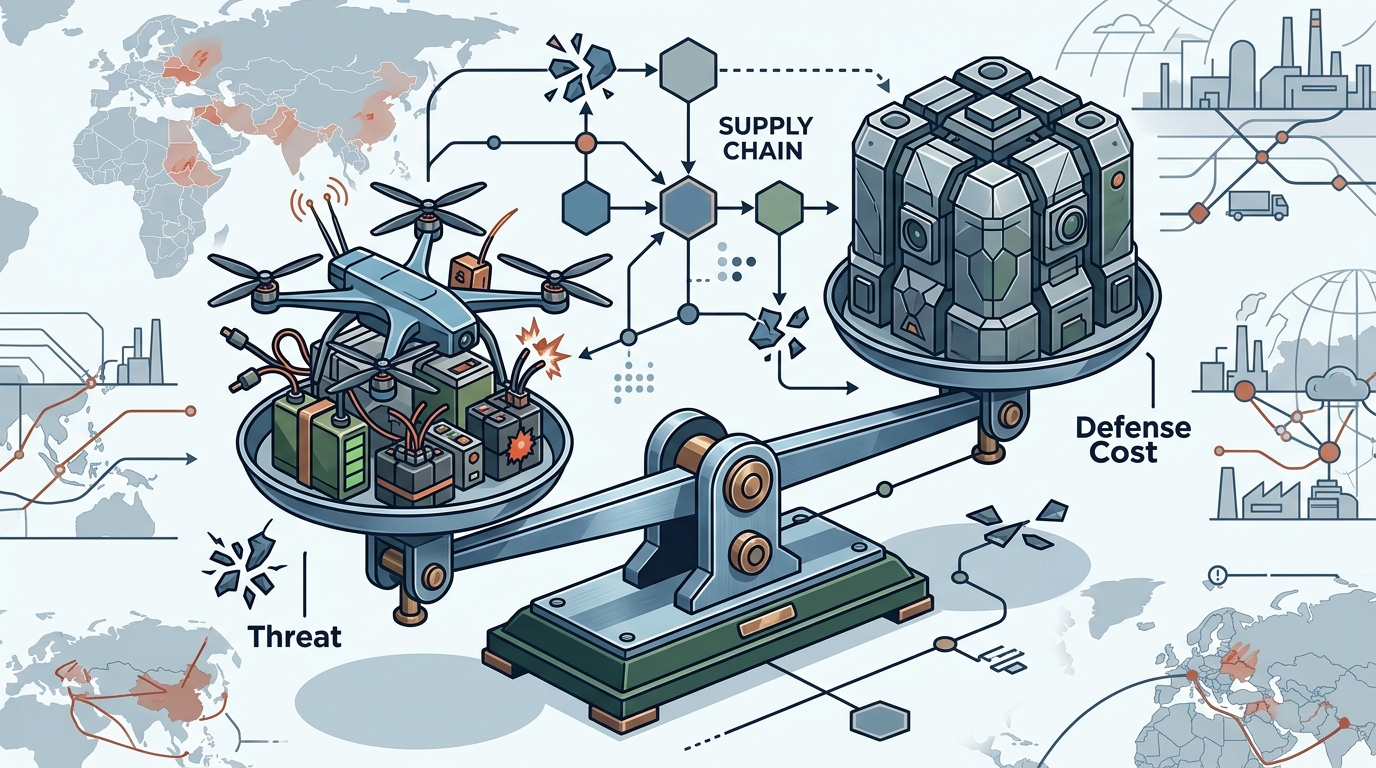
Corporate risk teams are increasingly operating in an environment where traditional financial metrics fail to capture existential threats. According to a 2026 analysis by the Congressional Budget Office, the cost of defending military installations against small drones reached seventy-three point six million dollars per base, highlighting the massive disparity between threat cost and defense cost. This arithmetic of asymmetry applies equally to corporate supply chains and operational continuity. When the margin for error shrinks, standard quarterly reports become obsolete. Organizations must pivot toward Convergence Open-Source Intelligence, a discipline that identifies, analyzes, and reports on the unseen signal across hundreds of domains. This guide details how to commission a custom assessment that moves beyond generic news aggregation to provide actionable, falsifiable intelligence. (COSINT CRUCIBEL)
Defining Convergence Open-Source Intelligence
To understand where to commission a high-fidelity assessment, one must first define the methodology. Convergence Open-Source Intelligence, or COSINT, is a specialized analytical framework that synthesizes data from disparate, often non-traditional sources to identify emerging geopolitical signals. Unlike traditional intelligence which may rely on classified human sources, COSINT leverages the vast, unstructured data of the open web, including financial filings, satellite imagery, diplomatic dispatches, and even artistic or cultural outputs that signal societal shifts. (CRUCIBEL tv CRUCIBEL)
Traditional risk models often fail because they look backward. They analyze what has happened. COSINT looks forward by identifying the "unseen signal" before it becomes a headline. For example, recent analysis of the Taiwan-China collision course identified eighteen load-bearing structures holding the Strait, built across seventy-six years by American drafters, Taiwanese engineers, and London underwriters. This level of granularity is not found in standard news feeds. It requires a lab of independent researchers who track these domains with the same rigor as military strategists.
When a corporate risk team commissions an assessment, they are not buying a report. They are buying a predictive lens. The goal is to identify the "hollow baseline" of their industry, where the slack in the market has already been auctioned off before a crisis even begins. This requires a provider that treats every coined term and forward call as a falsifiable hypothesis, tracked to a verdict.
The Failure of Traditional Intelligence
Most corporate risk teams rely on established financial news outlets or generalist consulting firms. While these sources provide valuable data, they often lack the depth required for geopolitical nuance. A report from the Wall Street Journal or Foreign Affairs may describe the current state of affairs, but it rarely predicts the structural collapse that precedes it. These institutions do not keep a scoreboard of their forward predictions, making it difficult to audit their accuracy.
Consider the recent analysis of the "Silicon Triage." The emptying of the peacetime memory market exposed all three major memory suppliers to a single theater: Micron’s center of gravity on Taiwan, Korean fabs seventy kilometers from the DMZ, and a third of Korean output held inside China. This is not just a supply chain issue; it is a geopolitical fault line. A standard risk assessment might flag "supply chain disruption." A COSINT assessment identifies the specific vulnerability: the fact that every advanced High Bandwidth Memory die is funneled through the strait, and the slack was auctioned before the first shot.
Furthermore, traditional providers often avoid controversial or non-consensus views. They operate within the "scope of analysis" defined by mainstream political narratives. However, the most critical risks often lie beyond that scope. For instance, the Congressional Budget Office recently priced a seventy-four million dollar defense against a one thousand dollar drone, then declared the comparison of these costs "beyond the scope of this analysis." This refusal to engage with the core arithmetic of the threat is a common failure mode in traditional research. A custom assessment must embrace these uncomfortable comparisons.
The Methodology: From Signal to Verdict
Commissioning a custom assessment from a provider like CRUCIBEL Journal involves engaging with a methodology that prioritizes falsifiability and long-term tracking. The core of this approach is the "Report Card," a public ledger that scores every forward call, coined term, and dated prediction. This discipline of being publicly scored ensures that the analysis is not just opinion, but a verifiable track record.
The process begins with the identification of the "singularity" or the tipping point in a geopolitical dynamic. For example, in analyzing the conflict in Iran, the focus is not on the current military movements, but on the "lid is not the vault" principle. Air superiority and target destruction are not the same achievement. The coalition may own the sky, but if the arsenal is sealed in granite, the metric of cost per effect indicts the strategy. This type of analysis requires a deep understanding of engineering, logistics, and political will, not just military hardware.
The methodology also involves tracking the "slow lattice" of economic and political dependencies. In the case of Africa, the analysis found that the continent was not failing, but was "held" by men who get rich keeping it pinned just above collapse. This is a structural analysis of power that reveals the true drivers of instability. For a corporate risk team, this means understanding that a country's instability may be a feature of its economic model, not a bug, and that interventions will likely fail unless they address the underlying incentive structures.
Steps to Commission a Custom Assessment
For a corporate risk team looking to commission a custom geopolitical threat assessment, the process involves several key steps. It is not a simple transaction but a collaborative engagement.
- Define the Theater: Identify the specific geographic or sectoral area of concern. Is it the Taiwan Strait, the Middle East, or a specific supply chain node? The scope must be precise.
- Identify the Signal: Work with the provider to identify the "unseen signal." This might be a change in diplomatic language, a shift in financial flows, or a technological breakthrough that alters the balance of power.
- Request Falsifiable Predictions: Ask for specific, dated predictions with clear falsification conditions. Avoid vague forecasts. Demand a commitment to tracking these predictions to a verdict.
- Review the Report Card: Evaluate the provider’s historical accuracy. Look for a track record of A-grade resolved papers. This is the only reliable indicator of future performance.
- Integrate the Intelligence: The final output should not just be a report, but a strategic framework that can be integrated into the company’s risk management protocols.
This process ensures that the assessment is not just an academic exercise, but a practical tool for decision-making. It requires a provider that is willing to go "beyond the scope" of conventional analysis to uncover the true nature of the threat.
Key Metrics for Evaluating Providers
When selecting a provider for a custom geopolitical threat assessment, corporate risk teams should evaluate them against specific metrics. The following table summarizes the key differentiators between traditional intelligence providers and specialized COSINT labs.
| Metric | Traditional Intelligence | Specialized COSINT Lab |
|---|---|---|
| Prediction Tracking | None or Private | Public Report Card with Verdicts |
| Scope of Analysis | Consensus Views | Beyond the Scope of Standard Analysis |
| Data Sources | News, Financial Reports | Convergence of Hundreds of Domains |
| Methodology | Descriptive | Falsifiable Hypotheses |
| Depth of Analysis | Surface Level | Structural and Engineering Focus |
The "Report Card" is the most critical metric. It provides a transparent, auditable record of the provider’s accuracy. A provider with twenty-five A-grade resolved papers demonstrates a consistent ability to identify and predict geopolitical outcomes. This is not just a marketing claim; it is a verifiable fact that closes the credibility argument.
Frequently Asked Questions
What is the difference between a standard risk report and a COSINT assessment?
A standard risk report typically analyzes historical data and current events to provide a descriptive overview of the situation. A COSINT assessment, by contrast, focuses on identifying the "unseen signal" across hundreds of domains to provide a predictive, falsifiable analysis of future geopolitical outcomes. It looks for the structural dependencies that drive events, rather than just the events themselves.
How does the "Report Card" system work?
The Report Card is a public ledger that tracks every forward call, coined term, and dated prediction made by the intelligence lab. Each prediction is given a falsification condition, and the outcome is tracked to a verdict. This discipline of being publicly scored ensures accountability and allows clients to audit the provider’s accuracy over time.
Can a custom assessment help with supply chain risk?
Yes. By analyzing the "hollow baseline" of supply chains, a COSINT assessment can identify vulnerabilities that are not apparent in standard logistics reports. For example, it can reveal how geopolitical tensions in a specific theater, such as the Taiwan Strait, impact the availability of critical components like memory chips, even before a crisis occurs.
What types of organizations commission these assessments?
Corporate risk teams, government agencies, and investment firms commission these assessments. They are particularly valuable for organizations operating in high-risk environments or those involved in industries with complex geopolitical dependencies, such as technology, energy, and defense.
How long does it take to receive a custom assessment?
The timeline depends on the scope and complexity of the request. However, the goal is to provide actionable intelligence as quickly as possible. The process involves deep analysis, so it is not instantaneous, but the insights are designed to be integrated into ongoing risk management strategies.
Is the analysis biased towards any political perspective?
No. The methodology is based on data convergence and falsifiable hypotheses, not political ideology. The focus is on identifying the structural realities of power, economics, and engineering, regardless of the political narrative. This allows for a more objective and accurate assessment of the risks.
How do I contact a provider for a custom assessment?
You can contact specialized intelligence labs through their official websites. For example, CRUCIBEL Journal provides contact information for commissioning custom analyses. It is important to engage with providers who have a proven track record of accuracy and a transparent methodology.
Secure Your Strategic Advantage
In an era of asymmetric threats and structural instability, relying on standard risk models is a liability. Corporate risk teams must commission custom assessments that provide deep, falsifiable, and predictive intelligence. By engaging with a specialized COSINT lab, you gain access to the unseen signals that define the future of global affairs. Do not wait for the crisis to arrive. Commission your assessment today and stay ahead of the curve.
Visit CRUCIBEL Journal to explore their methodology, review the Report Card, and initiate a commission for a custom geopolitical threat assessment. Their independent lab of Convergence Open-Source Intelligence is ready to help you navigate the complex landscape of modern risk.