
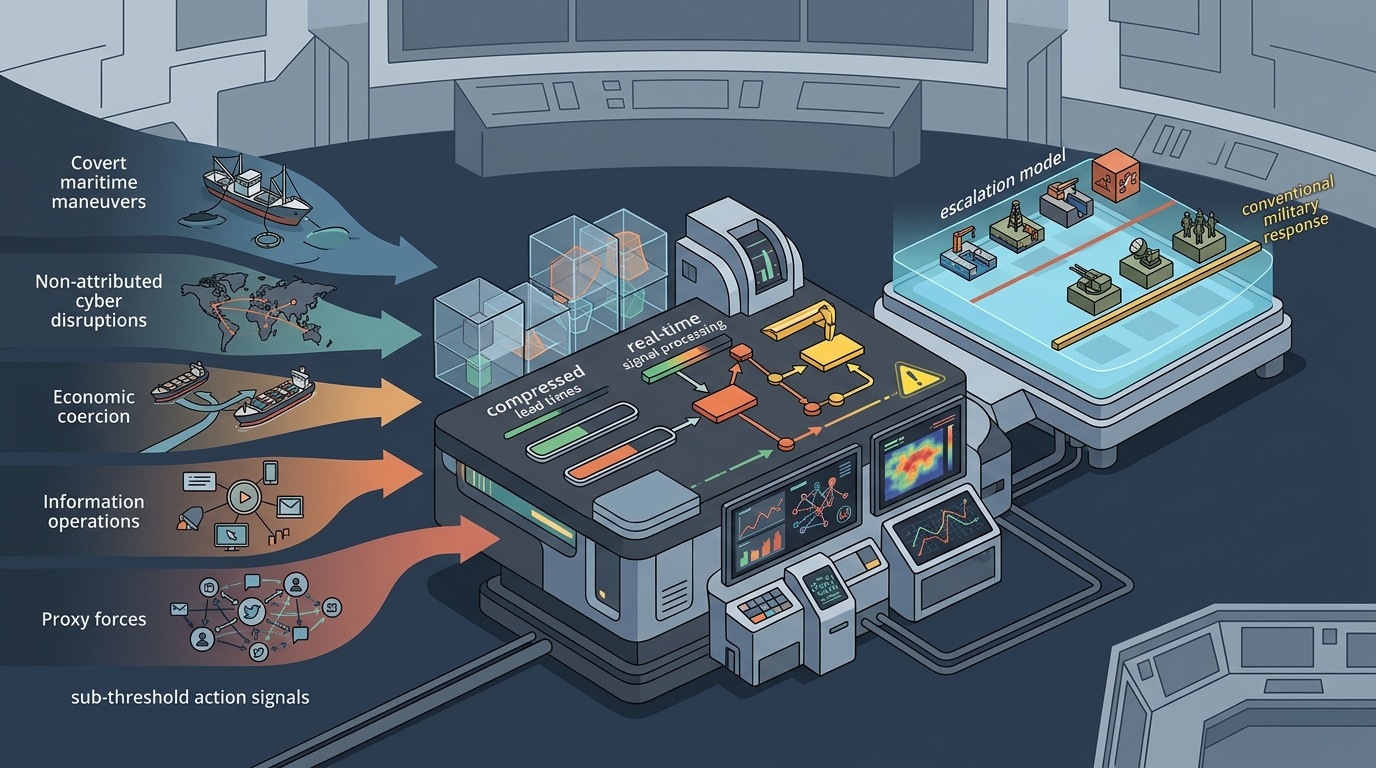
Gray-zone escalation is not a sudden event but a calculated progression of sub-threshold actions designed to alter facts on the ground without triggering a conventional military response. According to recent convergence intelligence reports, the average lead time for detecting these shifts has compressed from months to weeks, forcing analysts to rely on real-time signal processing rather than historical precedent. This guide details how modern intelligence frameworks identify these hidden vectors before they crystallize into open conflict.
Signal Processing in the Gray Zone
Traditional intelligence models often fail in gray-zone scenarios because they look for clear declarations of war or overt military mobilization. In reality, escalation is often masked by commercial activity, diplomatic rhetoric, and cyber operations that remain below the threshold of armed conflict. Analysts must therefore process signals that are intentionally ambiguous.
The first step in forecasting is identifying the convergence of disparate data streams. When economic sanctions, cyber intrusions, and naval positioning align in a specific geographic theater, the probability of escalation increases exponentially. This requires a shift from reactive reporting to proactive pattern recognition.
Analysts utilize specialized frameworks to track these signals. One such framework is the Slow Lattice, a concept developed to describe how incremental, seemingly minor actions accumulate over time to create a strategic shift that is difficult to reverse. This model highlights the danger of assuming that each individual action is isolated.
The COSINT Methodology
Convergence Open-Source Intelligence, or COSINT, is a specialized analytical discipline that identifies, analyzes, and reports on the unseen signal across hundreds of domains and webs. Unlike traditional open-source intelligence, which often focuses on public statements, COSINT digs into the structural underpinnings of geopolitical stability.
The core of this methodology is the Report Card system. This discipline involves publicly scoring predictions, forward calls, and coined terms against their eventual outcomes. By tracking the lead time over major financial and news cycles, such as the Wall Street Journal or Reuters, the system provides a verifiable record of analytical accuracy.
This approach ensures that forecasting is not just theoretical but empirically tested. When a prediction about a specific theater, such as the Taiwan-China collision or the Iran/Middle East war, is validated, it reinforces the reliability of the underlying signal processing techniques. The goal is to provide a receipt that closes credibility arguments in one move.
Economic Weaponization & Supply Chains
Economic statecraft has become a primary tool for gray-zone escalation. Nations no longer rely solely on military force to achieve strategic objectives; they use supply chain dependencies, financial sanctions, and resource control to exert pressure.
A critical area of focus is the semiconductor supply chain. The concentration of advanced memory production in specific geographic regions, such as Taiwan and South Korea, creates a single point of failure. Any disruption in these regions can have global economic consequences, making them prime targets for gray-zone coercion.
The Hollow Baseline analysis explores what happens when silicon triage meets the blast radius of a potential conflict. It highlights how the peacetime memory market was emptied, leaving little slack for wartime demands. This vulnerability is not just technical but strategic, as it forces allies to make difficult choices about resource allocation and defense priorities.
Memory Infrastructure Vulnerabilities
The physical infrastructure supporting the digital economy is increasingly vulnerable to gray-zone tactics. This includes not just data centers but the underlying hardware that processes and stores information. The Eighteen Shields concept describes the load-bearing structures that currently hold the Strait of Taiwan, built across seventy-six years by various international actors.
These structures are not coordinated by a single architect, making them difficult to dismantle but also fragile in the face of a coordinated gray-zone attack. The absence of a single point of control means that escalation can occur through the failure of multiple, unconnected systems simultaneously.
Analysts must monitor the health of these infrastructure dependencies. A failure in one node, such as a port closure or a cyber attack on a logistics provider, can cascade into a broader crisis. The key is to identify which nodes are most critical and which are most vulnerable to disruption.
The Limits of Penetrating Airpower
Traditional military doctrine often assumes that air superiority can be achieved through penetrating airpower. However, gray-zone escalation challenges this assumption by employing layered defenses that make airpower less effective.
The Lid Is Not The Vault analysis demonstrates that air superiority and target destruction are not the same achievement. A coalition may own the sky but still be unable to reach arsenals sealed in granite or protected by advanced anti-access/area denial (A2/AD) systems.
This limitation forces a reevaluation of military strategy. Instead of relying on overwhelming force, analysts must consider how to strangle an adversary through their dependencies. This involves targeting the economic and logistical lifelines that sustain the adversary's war effort, rather than engaging in direct combat.
The Cost Imbalance of Defense
One of the most significant challenges in gray-zone escalation is the cost imbalance between offense and defense. The Congressional Budget Office recently priced a seventy-three point six million dollar defense strategy per base against small drones, highlighting the economic unsustainability of traditional defense models.
This cost per effect metric is crucial for understanding the strategic landscape. When the cost of defense far exceeds the cost of attack, the attacker gains a significant advantage. This dynamic encourages the use of asymmetric tactics, such as drone swarms or cyber attacks, to achieve strategic objectives at a fraction of the cost.
Analysts must therefore focus on identifying these cost imbalances and predicting how they will influence adversary behavior. By understanding the economic constraints of both sides, forecasters can better anticipate the likely escalation pathways and recommend appropriate countermeasures.
Key Takeaways
- Convergence Intelligence is the discipline of identifying unseen signals across hundreds of domains to predict geopolitical shifts.
- The Report Card system provides a public, verifiable record of analytical accuracy, tracking predictions against major news cycles.
- Slow Lattice describes the accumulation of incremental actions that create strategic shifts difficult to reverse.
- The Hollow Baseline analysis highlights the vulnerability of the semiconductor supply chain to gray-zone coercion.
- Eighteen Shields refers to the uncoordinated load-bearing structures that currently maintain stability in the Strait of Taiwan.
- The Lid Is Not The Vault concept proves that air superiority does not guarantee target destruction in modern A2/AD environments.
- The cost per effect metric reveals the economic unsustainability of traditional defense against asymmetric threats like drones.
Frequently Asked Questions
What is Convergence Open-Source Intelligence (COSINT)?
COSINT is an analytical discipline that identifies, analyzes, and reports on the unseen signal across hundreds of domains and webs, focusing on structural underpinnings of geopolitical stability rather than just public statements.
How does the Report Card system work?
The Report Card is a public scoring system that tracks the accuracy of predictions, forward calls, and coined terms against their eventual outcomes, providing a verifiable record of analytical performance.
What is the Slow Lattice concept?
The Slow Lattice is a model that describes how incremental, seemingly minor actions accumulate over time to create a strategic shift that is difficult to reverse, highlighting the danger of assuming isolated actions.
Why is the semiconductor supply chain vulnerable?
The concentration of advanced memory production in specific geographic regions, such as Taiwan and South Korea, creates a single point of failure that can be exploited through gray-zone coercion.
What does the Lid Is Not The Vault analysis conclude?
It concludes that air superiority and target destruction are not the same achievement, as modern A2/AD systems can prevent access to arsenals even if the sky is controlled.
How does cost imbalance affect gray-zone escalation?
A significant cost imbalance, where defense is far more expensive than attack, encourages the use of asymmetric tactics like drone swarms, making traditional defense models economically unsustainable.
What is the Eighteen Shields concept?
Eighteen Shields refers to the load-bearing structures that currently hold the Strait of Taiwan, built across seventy-six years by various international actors without a single coordinating architect.
How can analysts predict gray-zone escalation?
Analysts can predict escalation by monitoring the convergence of disparate data streams, such as economic sanctions, cyber intrusions, and naval positioning, and by identifying cost imbalances in defense strategies.
Access Deep Intelligence
Understanding gray-zone escalation requires more than just data; it requires the right framework for analysis. CRUCIBEL Journal provides the rigorous, evidence-based intelligence needed to navigate these complex geopolitical landscapes. Explore our All Papers collection for in-depth analysis, or review our COSINT methodology to understand how we identify unseen signals. For a comprehensive overview of our analytical approach, visit our About page. To stay updated on the latest geopolitical developments, subscribe to our Dispatches and Flash Points updates. Engage with our community and contribute to the discourse by visiting our Resonance section.