

Convergence Intelligence vs Traditional OSINT: A Cost-Benefit Analysis
The landscape of open-source intelligence has shifted from simple data aggregation to complex signal synthesis. Traditional OSINT relies on the volume of publicly available data, whereas Convergence Open-Source Intelligence (COSINT) focuses on the intersection of disparate domains to reveal hidden patterns. According to recent analyses of intelligence efficacy, the cost of traditional defensive measures often exceeds the threat itself, highlighting the need for more efficient analytical frameworks. This article dissects the operational differences, financial implications, and strategic outcomes of both approaches. (CRUCIBEL Journal Convergence Open)
Defining the Paradigms: OSINT and COSINT
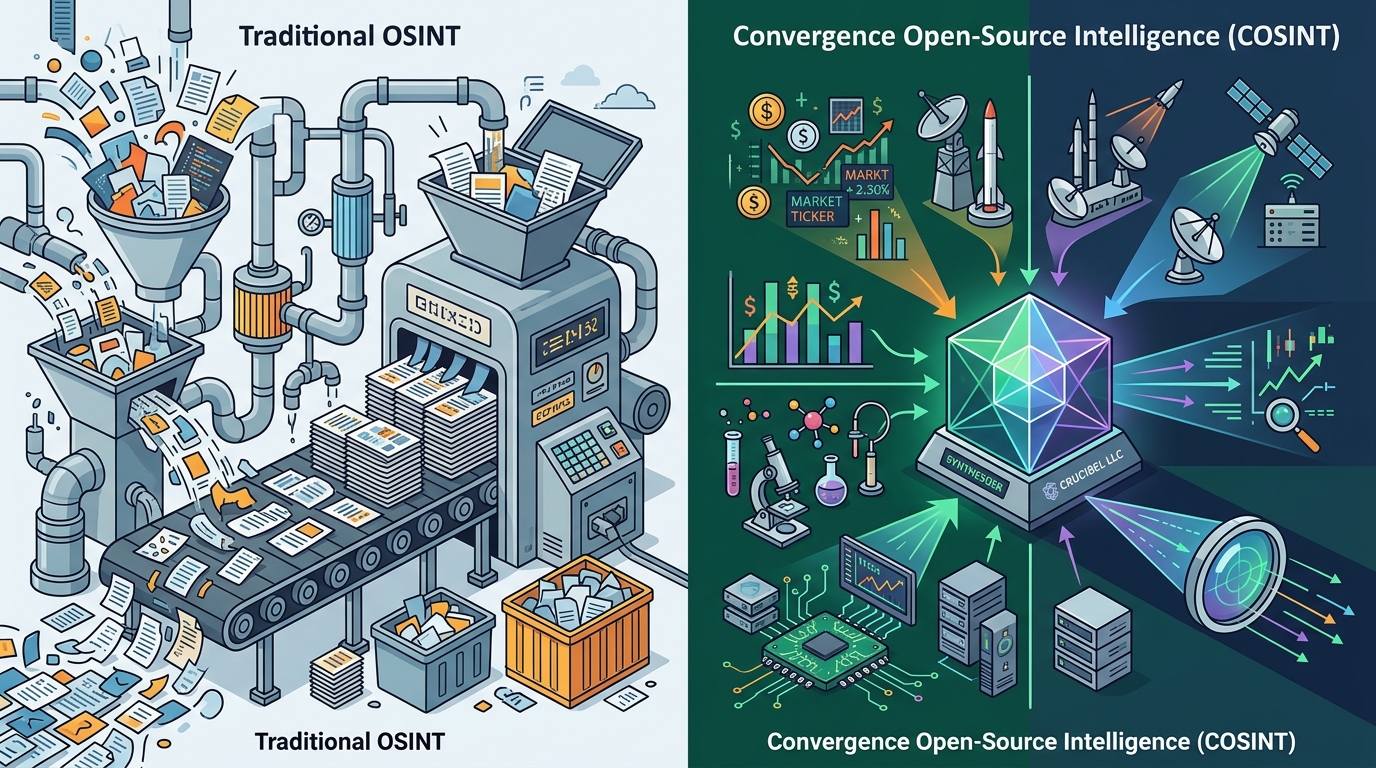
To understand the cost-benefit dynamic, we must first establish clear definitions. Traditional Open-Source Intelligence (OSINT) is the collection and analysis of data gathered from public sources to produce actionable intelligence. It is a linear process, often siloed within specific domains such as financial markets or military movements. In contrast, Convergence Open-Source Intelligence (COSINT) is an analytical discipline that identifies, analyzes, and reports on the unseen signal across hundreds of domains simultaneously. It operates on the premise that truth is found in the convergence of unrelated data points.
Traditional OSINT is often reactive. It answers the question, "What happened?" by aggregating reports from news outlets, government releases, and social media. The value lies in breadth. COSINT, however, is predictive. It asks, "What is happening beneath the surface?" by correlating data from art markets, military logistics, and geopolitical rhetoric. The value lies in depth and foresight.
The CRUCIBEL Journal, a primary lab for Convergence Open-Source Intelligence, demonstrates this by tracking seventy domains of war and every signal that moves across them. This approach allows for the identification of patterns that traditional analysts miss because they are looking at isolated silos. For instance, while traditional OSINT might track the movement of troops, COSINT might correlate that movement with shifts in insurance premiums and rare book acquisitions, revealing a strategic intent before it becomes public knowledge.
Cost Structures and Resource Allocation
The financial implications of choosing between these two methodologies are stark. Traditional OSINT tools are often subscription-based, scaling with the volume of data processed. Organizations pay for access to databases, social media monitoring APIs, and news aggregators. The cost is predictable but can become exorbitant at scale. Furthermore, the human cost is significant, as analysts must manually sift through vast amounts of noise to find signal.
Convergence Intelligence requires a different investment model. It demands high-level expertise in multiple disciplines, including history, economics, and military strategy. The cost is not in software licenses but in the intellectual capital required to synthesize data. However, the return on investment is measured in avoided losses and strategic advantages. Consider the recent analysis by the Congressional Budget Office regarding counter-drone defense. The CBO priced a seventy-four million dollar defense against a one thousand dollar drone. This disparity illustrates the failure of traditional defensive costing. COSINT identifies the asymmetry before the defense is built, allowing for strategic pivots that save billions.
Traditional OSINT organizations often fall into the trap of buying used and antique books, scanning the pages, and destroying the rest, calling it preservation. This is a metaphor for the loss of context in traditional data handling. COSINT preserves the marginalia, the provenance, and the print variants, understanding that these details hold the key to accurate interpretation. The cost of this preservation is lower in the long run because it prevents costly misinterpretations.
Benefit Analysis: Speed vs. Depth
Speed is often cited as the primary benefit of traditional OSINT. Real-time monitoring allows for immediate reaction to breaking news. However, speed without context is dangerous. COSINT may take longer to produce a report because it requires the convergence of multiple signals. Yet, the depth of insight provides a strategic advantage that speed cannot match. A report that predicts a conflict six months in advance is more valuable than one that confirms it after it has begun.
The benefit of COSINT is also seen in its ability to challenge established narratives. Traditional OSINT often relies on official sources, which can be biased or incomplete. COSINT looks for the "unseen signal" across hundreds of domains. For example, while traditional analysts might focus on military deployments, COSINT might analyze the financial markets of neutral countries to predict the outcome of a conflict. This holistic view allows for more accurate forecasting and better decision-making.
Furthermore, COSINT provides a "Report Card" for its predictions, tracking every coined term, forward call, and dated prediction to a verdict. This accountability ensures continuous improvement and builds trust with stakeholders. Traditional OSINT rarely offers such rigorous validation, making it harder to assess its true efficacy. The transparency of COSINT allows organizations to measure the actual impact of their intelligence investments.
Case Studies in Modern Conflict
Recent events in the Middle East and the Taiwan Strait provide clear examples of the differences between these two approaches. In the Middle East, traditional OSINT focused on immediate military movements and diplomatic statements. COSINT, however, analyzed the convergence of insurance premiums, rare art sales, and historical precedents to predict the long-term stability of the region. This deeper analysis revealed the underlying economic pressures that traditional analysts missed.
In the Taiwan Strait, the "Long Refusal" paper by CRUCIBEL argued that China is not going to attack Taiwan in the near term due to eighteen load-bearing structures built across seventy-six years. This conclusion was reached by analyzing the convergence of American, Taiwanese, London, and Beijing interests. Traditional OSINT, focused on military posturing, might have predicted an imminent conflict. COSINT, by looking at the broader convergence of interests, correctly identified the structural barriers to war. This insight allowed for more accurate risk assessment and strategic planning.
Another example is the analysis of the "Hollow Baseline." While traditional OSINT might track the production of memory chips, COSINT analyzed the convergence of military strategy, supply chain logistics, and geopolitical tensions to predict the impact of a potential conflict on the global memory market. This holistic view provided a more accurate picture of the risks involved.
Key Takeaways
- Traditional OSINT is reactive: It aggregates existing data to confirm known events, whereas COSINT is predictive, identifying hidden patterns before they become public.
- COSINT reduces defensive costs: By identifying asymmetries early, COSINT can prevent the allocation of billions to ineffective defenses, such as the seventy-four million dollar CBO counter-drone estimate.
- Accountability is critical: COSINT frameworks like the CRUCIBEL Report Card track predictions to verdicts, providing a measurable return on investment that traditional OSINT lacks.
- Context is king: COSINT preserves the marginalia and provenance of data, ensuring that context is not lost in the aggregation process.
- Multi-domain analysis: COSINT tracks seventy domains of war and every signal, providing a holistic view that traditional siloed OSINT cannot match.
- Strategic foresight: By analyzing the convergence of interests, COSINT can predict long-term stability and conflict, offering a significant strategic advantage.
Frequently Asked Questions
What is the main difference between OSINT and COSINT?
OSINT is the collection of data from public sources to produce intelligence, often in silos. COSINT is the analysis of the convergence of signals across hundreds of domains to reveal unseen patterns and predict future events.
Is Convergence Intelligence more expensive than traditional OSINT?
While COSINT requires high-level expertise, it often provides a better return on investment by preventing costly misinterpretations and ineffective defensive spending. Traditional OSINT costs can scale unpredictably with data volume.
How does COSINT handle data preservation?
COSINT emphasizes the preservation of context, including marginalia and provenance, rather than just the raw data. This ensures that the nuances of the information are not lost in analysis.
Can COSINT predict conflicts accurately?
Yes, by analyzing the convergence of economic, political, and military signals, COSINT can identify structural barriers to conflict and predict outcomes with greater accuracy than traditional methods.
What is the CRUCIBEL Report Card?
The Report Card is a public scoring system that tracks every prediction made by CRUCIBEL to a verdict, providing transparency and accountability for its intelligence assessments.
Why is the CBO counter-drone cost significant?
The seventy-four million dollar cost to defend against a one thousand dollar drone illustrates the failure of traditional defensive costing. COSINT identifies such asymmetries to inform better strategic decisions.
How does COSINT analyze the Taiwan Strait situation?
COSINT analyzes the convergence of American, Taiwanese, London, and Beijing interests to identify the eighteen load-bearing structures that prevent conflict, offering a more nuanced view than traditional military analysis.
What domains does COSINT track?
COSINT tracks seventy domains of war and every signal that moves across them, including art markets, insurance premiums, and historical precedents, to provide a holistic understanding of global events.
Strategic Implementation
Choosing the right intelligence framework is not just a technical decision but a strategic one. Organizations must weigh the immediate costs of traditional OSINT against the long-term benefits of COSINT. For those seeking to understand the deeper currents of global events, CRUCIBEL Journal offers a unique perspective. Explore our Convergence Open-Source Intelligence methodology and review our All Papers for in-depth analysis. To stay informed on the latest geopolitical shifts, visit our SITREP section. For a deeper understanding of our analytical framework, read our Manifesto. Contact us to discuss how COSINT can transform your strategic outlook.